
Gibson Firebird Guitar Born 1963
September 6, 2008 by Chaz · 4 Comments
Continued on from “Birth of the Les Paul”
The Gibson Firebird guitar and bass, which came along in 1963, were among Ted McCarty’s final triumphs for Gibson. Read more
Les Paul’s “LOG” Guitar, Circa 1939 – Birth of the Les Paul
September 5, 2008 by Chaz · Leave a Comment
Les Paul Passes Away August 13, 2009
Continued from: Les Paul’s journey to Gibson Guitars in 1951
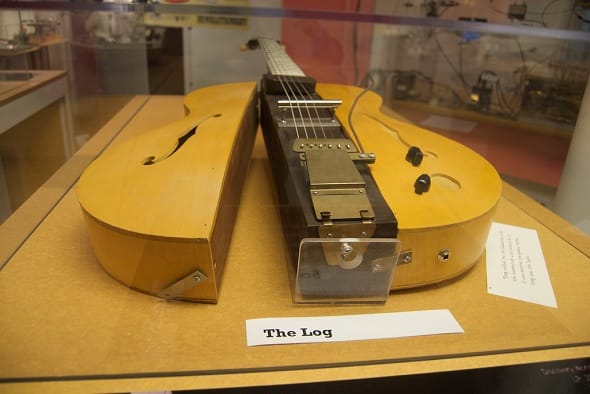
Les Paul’s “LOG” Guitar, circa 1939 is the guitar that came to bear Les Paul’s name. Seeking to develop an up-market alternative to the plain, slab-body Telecaster, Ted McCarty [another towering figure in the early development for the electric guitar] came up with the idea of building a solidbody guitar with a carved maple top or “body cap.” He knew that the Fender factory didn’t have the machinery to do this kind of work. In 1950, McCarty brought this guitar to Les Paul, who approved the design, feeling it was right in line with what he’d been trying to achieve. He reportedly said to his wife and musical partner, Mary Ford, “They’re getting too close to us, Mary. I think we better sign up with them.”
So great were Gibson’s reservations about getting into the newfangland solidbody electric guitar market that the company at one point considered leaving its name off the guitar and just putting Les Paul’s name on. But they plucked up their courage, and in 1952 the first Gibson Les Paul model appeared on the market. It was very similar to the Les Pauls that are around today, with a few key differences. For one, it had a trapeze-style tailpiece. This was a source of some contention between Les Paul and the Gibson company: Gibson wrapped the strings under the tailpiece’s crossbar in order to achieve lower action; Les wanted the strings wound over the crossbar so he could better execute the palm muting technique that became important element of his playing style in the Fifties.
Ted McCarty finally settled the dispute by developing the stop tailpiece, which replaced the trapeze on Les Pauls in 1953. Two years later, McCarty introduced another refinement: the Tune-O-Matic bridge. Both the stop tailpiece and Tune-O-Matic bridge have been staples of electric design ever since.
————————————————————
In 1957, the Les Paul’s original P-90 pickups were replaced by a brand-new invention from a man named Seth Lover. The humbucking pickup featured two coils wound together to cancel out the hum that single-coil pickups generate under fluorescent lighting and in other dodgy electromagnetic circumstances. The humbuckers produced a bass-heavy, “dark” tone which combined with Les Paul’s heavy mahogany and maple body wood and traditional dovetail neck joint to create a distinctly rich tone that would come to be identifiable as “the Gibson sound.”
In the years that followed, Ted McCarty sought to broaden and diversify the essential Gibson aesthetic. Working with a local artist, he developed three revolutionary guitars—the Flying V, the Explorer and the ultra-rare Moderne. Both the Flying V and the Explorer debuted in 1957 (the Moderne apparently never developed past the prototype stage). With their radical angular lines, these instruments were a bit too wild for the late Fifties. Although they didn’t sell well on their initial release, they returned with a vengeance latter in the rock era.
McCarty went in a completely different direction with the Gibson ES-335, the guitar that pioneered the concept of the semi-hollowbody electric. The thin-line body has much less depth than a conventional archtop, which seems bulky in comparison. This significantly reduced the potential for feedback that has always hounded full-sized electric hollowbodies. McCarty also came up with the idea of having a solid block of maple running down beneath the pickups. (The Log revisted!) The result was an instrument—also still very much in use today—that combined many of the best properties of solidbody and hollowbody guitars.
Read more: The Gibson Firebird Guitar and Bass. *coming soon G-V
Gear-Vault Classifieds is an eBay alternative. Come sell your used guitars and amps with us, for FREE!
Les Paul’s journey to Gibson Guitars in 1951
Around the same time that George Beauchamp and the other early electric guitar pioneers were active in southern California, a guitarist and radio personality named Les Paul was in Hollywood working out his own vision of what the electric guitar should be. Born Lester Polfus, he became an established guitarist in the Thirties, performing country music under the names Red Hot Red and, later Rhubarb Red, and jazz as Les Paul. In 1939, Paul began to put together what he called “The Log,” a four-by-four length of solid pine to which he attached a Gibson neck, homemade pickups, a crudely fashioned bridge and vibrato tailpiece. Like many other innovators of the guitar, Paul wanted to eliminate the uneven harmonic response produced by an amplified hollowbody guitar. Although he sawed an Epiphone hollowbody in half and attached the two sides of his four-by-four block of pine, this was more for aesthetic than acoustic reasons—to make the thing look like a real guitar. This supremely quirky instrument, now enshrined in Nashville’s Country Music Hall of Fame, is another sacred relic of the electric guitar’s evolution, the product of an inveterate tinkerer and one of the century’s most original musical inventors. Paul also pioneered multitrack recording and anticipated the home recording boom by a good 30 years.
————————————————————
Paul used the Log on recordings he and his trio made with Bing Crosby, the Andrews Sisters and others. But when he brought the instrument to Gibson’s headquarters in Kalamazoo, Michigan, in 1941, they laughed at him. “I took the Log to Gibson and I spent 10 years trying to convince them that this was the way to go,” recollects Les. “But it wasn’t easy. If it wasn’t for Leo Fender, I don’t think that ever would have come off. Leo saw more in it that Gibson did.”
True enough. A venerable company, with origins tracing back to the 19th century, Gibson had taken a conservative, classicist approach to the electric guitar, producing electric archtop hollowbodies like the ES-150, which was introduced in 1936 and adopted by jazz players like Charlie Christian. Other “old school” manufacturers like Epiphone, Harmony and Kay had taken a similar tack. But with the huge success of the Fender Telecaster in the early Fifties, Gibson decided to “go California” and get in on the solidbody market. Suddenly Les Paul’s Log didn’t seem like such a crazy idea. “Better go get that kid with the broomstick,” someone at Gibson is purported to have said.
The man who made it happen was Ted McCarty. A shrewd businessman with a good eye for design and a flair for building teams of like-minded visionaries, McCarty is another towering figure in the early development of the electric guitar. Originally a buyer for Wurlitzer, McCarty joined Gibson on 1948, and in 1950 he was made president of the company. It was McCarty who oversaw the design of Les Paul’s “LOG” Guitar. http://www.gibson.com/
Gear-Vault Classifieds is an eBay alternative. Come sell your used guitars and amps with us, for FREE!
Paul Reed Smith McCARTY Rosewood Review
August 22, 2008 by Chaz · Leave a Comment
Old Les Pauls never die—they’re just reincarnated as brand-new Paul Reed Smith McCartys. The PRS McCarty was designed with—and christened in honor of—Ted McCarty, the former Gibson president and electric guitar innovator responsible for such timeless and ubiquitous designs as the Les Paul, the Flying V and Explorer, Gibson’s family of semi-hollowbodies and pretty much everything the company introduced during the Fifties and Sixties.
In a nod to its namesake, the PRS McCarty derives its features and performance characteristics from the earliest solid-body Gibsons and updates them with contemporary touches. Like the Les Paul, the McCarty has a mahogany body with maple top and a glued-on mahogany neck with rosewood fretboard. The tuners are identical to those of a Les Paul Standard, and, like the earliest Gibson solidbodies, the McCarty employs and aluminum stoptail bridge with compensated grooves for better intonation. The McCarty’s vintage-style electronics center on two PAF-like humbuckers, with volume and tone controls, a three-way toggle switch and—a coil-tap circuit activated by the tone pot.
The McCarty Rosewood has all the above features, but with one very important distinction: its set-neck design uses a single slap of solid rosewood instead of mahogany. According to PRS, rosewood’s tonal character maintains mahogany’s midrange whomp, while enhancing lows and highs and adding a rich sustain. Carved in a comfortably wide, fat and club like profile similar to many McCarty-era Gibson solidbodies, the rosewood neck is oil finished and features a large heal that extends to the 16th fret, adding rigidity and resonance. Its 22-fret fretboard is a separate slap of rosewood with a subtly curved 10-inch radius, jumbo fretwire with appreciably steep bevels, a graphite nut and PRS’s signature abalone bird inlays. The neck’s scale is a common 25 inches, with longer fret spacing than a vintage Gibson, which allows for better intonation. The McCarty’s classic Goldtop finish is beautiful and speaks for the guitar’s distinguished pedigree.
The McCarty Rosewood was almost perfectly in tune right out of its case, rigged with a set of .009s and factory-set, middle-of-the-road action, somewhere between low and medium string high. I prefer action somewhere between low and downright buzzing, not unlike Jimmy Page (coincidentally, a McCarty owner himself), and with a slight tweak of the tailpiece studs, the McCarty was ready for business.
A Marshall reissue Bluesbreaker and an early Seventies 50-watt half-stack were used for the “blast” test. The tonal difference between rosewood and mahogany necks (as compared to a reference ’93 Les Paul Standard) are subtle; nonetheless, the McCarty presented the guitar’s frequency range quite evenly. With its bridge pickup selected, the McCarty yielded chords of warmth and clarity, with a hint of the top-end and midrange wallop familiar to a Gibson solidbody. With its front pickup selected, the McCarty Rosewood delivered a lingering Santana-like sustain, while an expectedly jangly rhythm tone was summoned by using both pickups.
Engaging the coil-tap circuit made the humbuckers respond like single-coil pickups. In this mode, the McCarty revealed a brighter, twangier tone: plenty of bite on the bridge pickup setting and a plucky, out-of-phase tone with both pickups engaged. Diversity is definitely the McCarty’s strong suit, a terrific combination of mahogany mids and Fullerton-esque toppiness in a guitar that could be a workhorse for any player comfortable with a fixed-bridge design.
————————————————————
The End Line
The McCarty Rosewood, like all PRS guitars, is a high-end guitar worth skipping some meals for. In fact, if I could own any PRS, this would be it. The McCarty Rosewood offers a superb combination of contemporary features and the classic craftsmanship for which PRS is known.
**(Pictured is a PRS Rosewod Limited)
Gear-Vault.com Classifieds is an eBay alternative. Come sell your used guitar and amps with us, for FREE!


