Join us at GEAR-MONKEY Message Boards
Powered by MaxBlogPress  
Top

Stevie Ray Vaughan – Forever Cherished

September 19, 2009 by Chaz · Leave a Comment 

Stevie Ray Vaughan - Forever CherishedThe first flash comes over the Associated Press wire at about 7 a.m. on Monday, August 27, 1990: “Copter crash in East Troy, Wisconsin. Five fatalities, including a musician.”

Keen-eyed staffers at the Austin American Statesman catch that item and begin putting two and two together. The AP updates its story every half hour with fresh details: The mysterious “musician” becomes “a member of Eric Clapton’s entourage”—and then, “a guitarist.” By 9:30, rumors spread that Stevie Ray Vaughan was aboard the doomed craft. Read more

Life & Death of Stevie Ray Vaughan

September 15, 2009 by Chaz · Leave a Comment 

Life & Death of Stevie Ray VaughanTo understand what made Stevie tick, to get the whole story of the man behind the music, we have to turn to his closest confidants, the people who knew him best and miss him most. Given the opportunity to tell Stevie’s tale and open up, revealing things they’d never revealed before. Read more

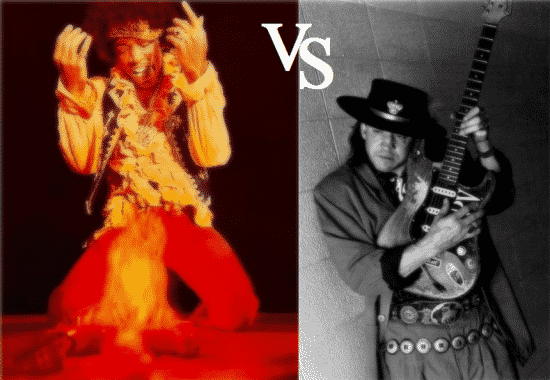
Fight Club: Jimi Hendrix vs. Stevie Ray Vaughan

August 2, 2009 by Mike O'Cull · 8 Comments 

Jimi Hendrix vs Stevie Ray Vaughan

Two of the most revered guitar players in the blues/rock universe are Jimi Hendrix and Stevie Ray Vaughan. Both men helped define the sounds of their respective eras and are icons of the instrument and are most likely responsible for launching more guitar-playing careers (both real and air) than any post-Beatle guitarist outside of Eddie Van Halen. Today, however, your humble man of letters here at Gear-Vault has been given the difficult task of pitting Jimi and SRV in a head-to-head battle for musical supremacy, which is truly no easy task. In the flyover, both man share many similar qualities, from their explosions into public consciousness to their preference for Fender Stratocasters to their untimely deaths. When examined more closely, however, there are some major differences between the two that just might give one the edge over the other. Want to watch the fur fly? Keep reading. Read more

Uni-Vibe Inspired Effects Pedals

November 21, 2008 by Chaz · Leave a Comment 

Vintage UniVibe effects pedalMultiple personality disorder may be a debilitating condition in humans, but it’s a delightful quirk in effects pedals. With small digital multi-effects pedal so prevalent these days, it’s always refreshing to check out a few analog stomp boxes that feature some pleasantly psychotic twists.

To that end, we subjected three effects pedals to analysis: three distortion related units—inspired by the venerable Uni-Vibe—Jim Dunlop’s Uni-Vibe Stereo Chorus, Fulton’s Deja Vibe and Roger Mayer’s Voodoo Vibe. While no two pedals were exactly alike in function, each possesses a dual nature that, when fully exploited revealed unique opportunities for extreme sonic manipulation. Any guitarist bored by conventional sounds will find plenty to get excited about in these boxes.

All three pedals were tested with fresh 9-volt alkaline batteries, and their signals were sent to a variety of amps including a Marshall JCM800, a Fender Pro and a cute little solid state Fender Bronco. We also fed Uni-Vibe—inspired units into a multi-channel mixer to better examine their stereo output.

JIM DUNLOP UNI-VIBE STERO CHORUS

Back in the day, organists who couldn’t afford a bureau-sized Leslie speaker cabinet would beef up the tone of their Farfisa and Vox combo organs with a little unit called the Uni-Vibe. Manufactured by the Univox Company, the Uni-Vibe did a fair job of replicating the Doppler effect of a Leslie cabinet’s rotating horn. And unlike a Leslie, it weighed far less than a small refrigerator. It was Hendrix, again, who dug the Uni-Vibe as a guitar effect, claiming it for future six-stringers like Eric Johnson and Stevie Ray Vaughan.

The Jim Dunlop Company, which owns the Uni-Vibe name, has been manufacturing several famous variations on the pedal for years. The Uni-Vibe Stereo Chorus can be thought as “one Uni-Vibe to go, hold the bells and whistles.” Unlike the Univox original, which consists of an AC-powered, book-sized enclosure connected to a speed-varying pedal, the Dunlop unit is of classic stomp-box proportions and runs on either a 9-volt batter or an adapter. Dunlop has also modified the circuit to vary continuously from “vibrato” to “chorus” (the original was an either-or proposition), and they’ve thrown in some clever stereo circuitry to boot.

The resulting sound is a solid simulation of the original. The chorus is whirly and whooshy, with plenty of air and phasing, while the vibrato imparts a mild pitch shift that undulates evenly throughout the entire range. There are no rude hiccups at the fast speeds, and the slow settings won’t give you that “who put the Quaaludes in my beer?” feeling. In addition to speed and intensity controls, the Uni-Vibe features a pilot light that faintly pulses in time to the speed settings.

The real fun comes when you work the mix control in association with the stereo output jacks. The mix ranges from “wide” to “mono,” and the outputs are labeled “left/chorus” and “right/vibrato”. With the mix set wide, the left output is dry and the right output is full, pitch-warbling vibrato. Pan the mix to mono and the left output comes alive with chorus, while the right channel’s vibrato gradually morphs into matching chorus. These various permutations give you the opportunity to use the Uni-Vibe with either the right output alone, varying the mix between vibrato and chorus, or with both outputs for a stereo spread that can range from vibrato-plus-dry to vibrato-plus-chorus (which sounded lovely in headphones) to dual-mono chorus.

With the Uni-Vibe in bypass mode, I was able to detect some signal coloration, a not unpleasant high-end sheen most evident in the pick attack. This minor complaint aside, the Uni-Vibe will please guitarists who want to add rotating speaker tone to their arsenal without breaking their back or spending an arm and a leg.

FULLTONE DEJA VIBE

If you are even remotely aware of Mike Fuller’s Fulltone pedals, you won’t be surprised to know that he’s nailed the vibe of the original Uni-Vibe. Fullton currently offers the Deja 1 (mono or stereo), which comes with a large knob for controlling the rate of speed, and the Deja 2 (mono or stereo), which features the more traditional pedal speed control. Although we set out to test a mono Deja Vibe 2, we were lucky enough to score a stereo Deja Vibe 1 in time to check out its dual-output capabilities. The controls on both units are simple and almost identical to the original Univox model: chorus/vibrato selector switch, intensity knob, on-off footswitch, speed pedal or knob and—perhaps the only concession to modern values—a “modern/dark” switch.

Advertisement————————————

————————————————————

Fullton pedals are known for both their stunning sound and rugged construction, and the Deja Vibe is no exception. The chorus and vibrato settings are warm and full, and the speed pedal gives you the ability to mimic the slow-to-fast rotary sound of a Leslie cabinet. Unlike the original pedal, the Deja Vibe has full bypass, so there’s no need to stick this in an effects loop to isolate it. About that modern/dark switch: the original Uni-Vibe was designed for the slightly higher and brighter outputs of compact organs, and the sound is somewhat dark when driven by a guitar. Flick the Deja Vibe from to dark to modern and you’ll get a nice little boost along with a less “loaded-down” tone. Furthermore, the stereo models feature true stereo output, creating a back-and-forth undulation in the sound field that none of the other Vibe pedals possessed.

The vibrato setting was especially nice with a slightly overdriven amp. Normally this is a recipe for disaster, since modulated pitch-shifting devices can get pretty ugly when distorted, but the Deja Vibe sounded like it was made for this purpose, achieving the wicked grind of Eric Clapton’s solo on “While My Guitar Gently Weeps.” That vibrato, by the way, has the loveliest bottom-end “thump.” I understand that connoisseurs of the original Uni-Vibe listen for just that thump when evaluating other units.

ROGER MAYER VOODOO VIBE

Roger Mayer didn’t invent the Uni-Vibe, but you can bet he spent plenty of time nipping and tucking at the guts of the models Hendrix owned. After Uni-Vibe production ceased, Mayer produced his Supervibe, used by both Stevie Ray Vaughan and Robin Trower. The Voodoo Vibe is the latest generation of this evolutionary chain, offering an immense amount of flexibility while remaining true to the Uni-Vibe tone.

The Voodoo Vibe is housed in a book-sized, cast-metal box with seven black pointer knobs. The function knob offers a choice of chorus, vibrato and (surprise!) tremolo. The speed of each effect can be set with the range knob, which chooses either a sine or triangle wave in slow medium or fast mode, and tuned in precisely with the fine knob. The intensity and output knobs vary the depth of the chosen effect and the final output of the signal, respectively, and the symmetry and bias controls actually shape the wave you’ve chosen, creating giddy roller-coaster sensations in the shower vibrato settings and helicopter-like “woof” sounds at faster speeds.

For those who desire the pedal option of the original Uni-Vibe, the Voodoo Vibes lets you control its speed by plugging any standard volume pedal into a couple of jacks on the back. The dual-output jacks are low impedance and deliberately active (though totally uncolored) for parallel processing and driving longer cable lengths. The power source can be either a 9-volt battery or an adaptor, and the Voodoo Vibe has a status LED.

The sound of the Voodoo is simply stunning. It was possible to teak it just so and imitate the original Uni-Vibe sound, but this unit is inspired by the Uni-Vibe, not just a clone or an upgrade of it. The vibrato effects call forth the aforementioned roller-coaster and helicopter sensations, as well as bubbly underwater effects, with ease. The chorus is so lush and full, it simply bears no comparison to the average pedal. And if you’ve been hoping to come across a vintage amp with a working tremolo circuit, save your time: the Voodoo Vibe can cop the shimmer of those old Fender, Vox and Ampeg tremolos, and go into some pretty extreme volume-chopping effects as well.

End Line – If the original Uni-Vibe sound is your Holy Grail, the Deja Vibe is your pedal. For a deep sound-shaping tool, check out Voodoo Vibe, a multifunctional monster that will put half a dozen little colored boxes out to pasture.

Buy – Sell – Trade at USED MUSIC GEAR at GEAR-VAULT CLASSIFIEDS

Godsmack Smack Attack

August 27, 2008 by Chaz · Leave a Comment 

GodSmack Sully Erna playing Gibson Les PaulWho says you need a big budget, a hotshot producer or a fancy, gazillion-track studio to make a hit record? Not Godsmack, a Boston-based band that sounds more like Seattle (their name actually comes from an Alice in Chains song). Godsmack’s selft-titled major label debut originated as a self-produced demo recorded back in 1996 for just $2,500—which the band had to borrow from a friend. Read more

Allman Brothers Sue Universal For $13 Million Over Royalties

August 12, 2008 by Chaz · Leave a Comment 

The Allman Brothers Band Sues Apple UGMSources tell us that The Allman Brothers Band has sued a record company for roughly $13 million. The Allman Brothers is taking a stand and are demanding a bigger cut of recordings sold through third parties, such as UGM and Apple’s iTunes music service.

The rock band claims it’s the victim of “digital exploitation,” theft from digital downloads. The Allman Brothers demand more royalties from sales.

The Southern rock band filed its lawsuit against UMG Recordings Inc. in federal court in Manhattan on Monday August 11th, 2008, saying it was the victim of “digital exploitation.”

The band behind such hits as “Melissa” and “Ramblin’ Man” demands at nearly $13 million and additional royalties from the sales of newly configured compact discs and digital downloads, such as for use on telephone ring tones.

Advertisement————————————

————————————————————

The Allman Brothers Band was formed in the late fall of 1968 and was inducted into the Rock and Roll Hall of Fame in 1995.

The lawsuit says that when the Allmans entered into a contract with Polydor in 1985 (Polydor was later bought by Universal), the deal called for the band to get paid half the profits of the sale of records by third parties, which includes iTunes downloads and ringtone sales. The band also accuses UMG of refusing to renegotiate the royalties and having a “wanton disregard” of their original contract. The lawsuit equals to about $1 for every second of “Mountain Jam.”

Gear-Vault Classifieds is an eBay alternative. Come sell your music equipment with us, for FREE!


The Allman Brothers Band

August 12, 2008 by Chaz · Leave a Comment 

The Allman Brothers Band May of 1969“He knew how to bring out the best in people,” says Gregg Allman of his late brother Duane, legendary guitarist and founder of the band which bears their surname. ”He knew which buttons to push.” Read more

Bottom