Top

Schecter C-1 FR Guitar Review

June 9, 2010 by G-v Rover · 1 Comment 

schecter-c-1-fr-diamond-series-guitar-reviewThe legacy of the Super Strat lives on with the Schecter C-1 FR, a dual-humbucker-equipped ax with Floyd Rose licensed tremolo and a familiar double-cutaway shape. With its Duncan Designed HB-105 active humbuckers, 25 ½-inch scale and 24-fret fingerboard, this is a great guitar to check out first if you’re looking for a high-octane shred machine. Read more

Seymour Duncan Yngwie Malmsteen YJM Fury Single-coil Pickups

February 10, 2010 by G-v Rover · Leave a Comment 

No other guitarist unleashes the fury like Yngwie J. Malmsteen. His influence is undeniable, his technique unparalleled. So, when a legendary axe-slinging metal virtuoso like Yngwie says he wants to take his tone to the next level, we listen. After hundreds of hours of intense tone pursuit, we proudly unleash the STK-S10 YJM Fury.

The YJM series includes a dedicated bridge pickup as well as a separate neck/middle pickup, representing two highly individual customized voices that sound sweet and fluid with more articulation and responsiveness to dynamics. They’re recommended for any fast playing style including neo-classical, shred, hard rock, power metal, and heavy metal and can directly retrofit most single-coil equipped guitars. But players beware, installing the YJM Fury into your guitar, might unleash the Fury in you.

Places To Buy


Shop at the World's Largest Music Gear Company!………………………………………………………………...............Check Price

Music123.com………………………………………………………………...............Check Price

American Musical Supply - your musical gear source………………………………………………………………...............Check Price

………………………………………………………………...............Check Price

Sam Ash Quikship Corp.………………………………………………………………...............Check Price

………………………………………………………………...............Check Price

GuitarCenter.com………………………………………………………………...............Check Price

Seymour Duncan 8-String Blackout Pickups

December 18, 2009 by Chaz · 2 Comments 

seymour-duncan-blackout-8-string

Seymour Duncan have leaked some information about the new 8-string Blackout pickups. This is great for the growing trend of 8-string guitars. We here at Gear-Vault have been reporting news about Schecter Guitar Research announcing 8-string guitars before the NAMM show–Schecter BlackJack ATC-8 limited edition guitar comes with 8-string Blackouts installed from the factory. Read the presser below. . . Read more

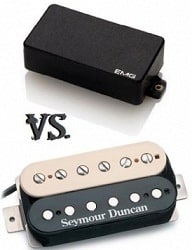
EMG vs. Seymour Duncan Electric Guitar Pickups

August 31, 2009 by Mike O'Cull · 1 Comment 


EMG vs. Seymour Duncan Electric Guitar PickupsElectric guitar pickups are a touchy and subjective topic. Most long-time players have gone through a number of different types before they work out what is the best sound for them. Sometimes they will even prefer different styles or brands of pickups for different applications. Today, we are doing a flyover comparison of two of the most popular makes of pickups on the market Read more

Fender Statocaster Pickups and Sounds

January 12, 2009 by Chaz · Leave a Comment 

Fender Statocaster Pickups and Sounds
I have a ’90 or ’91 second-hand Japanese Fender Strat. I love the guitar, but its sound is starting to wear on me. I’ve tried different amplifiers, pedals and everything, but it’s impossible to escape those thin, glassy, Clapton / Hendrix / Cobain wannabe tones. I want to sound like me. Read more

A look at Washburn Idol Series

January 7, 2009 by Chaz · 2 Comments 

Washburn Idol Series WIWe noticed that not much information was presented on the interweb about Washburn’s Idol series guitars. That’s a shame because these guitars are an absolute craft of beauty and extremely underrated. There has never been a better time to choose your Idol with the recently released (October 2008) models available.

Washburn’s “Wi” Idol series are passionately hand-built at the Washburn’s Chicago facility by some of America’s finest luthiers, the USA Idol Series consists of five amazingly crafted Custom Shop Guitars. Read more

Washburn P4 Deluxe Guitar – taking a look back

January 2, 2009 by Chaz · 5 Comments 

Washburn P4 Deluxe Guitar
Washburn’s P-series were a fine instrument, especially the P4 Deluxe. The guitar was introduced in early 1997, featuring a mahogany body with a flamed maple top that was so beautiful that you would literally drool down your chin.

The guitar also featured Washburn’s (exclusive) sound chambers, which made the guitar extremely lightweight and resonant. The P4 came from the factory with Seymour Duncan classic ’59 and custom humbuckers installed, the tone was absolutely to die for.

Also included in the P4 Deluxe was Schaller locking tuners and a fine-tuning tailpiece, which was designed to give you full control over tuning with the added benefit of a graphite nut. The instrument was available in a variety of burst colors, including Wineburst, Cherry Sunburst, Blueburst, Honeyburst, Coffeeburst and Tobaccoburst.


Advertisement————————————

————————————————————

Twin Tube Mayhem Death in a Box

October 10, 2008 by Chaz · Leave a Comment 

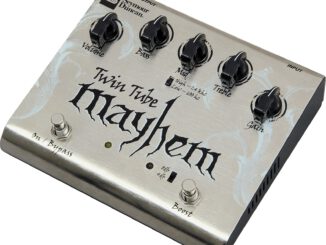
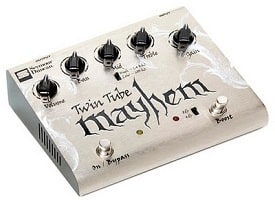
Seymour Duncan Twin Tube Mayhem SFX-04

I’m always excited when new pedals are released. One of the more recent releases was Seymour Duncan’s Twin Tube Mayhem SFX-04, which is a balls-to-the-wall full-range tube driven distortion pedal jam-packed with welcoming features. It comes with your standard EQ–Treble, Mid, and Bass controls but a great added feature is the mid boost switch from 600hz to 1.4khz. The Mayhem also has a foot-switchable boost that you can set to either +4dB or +8dB. Loaded with gain, the Mayhem is perfect for hard rock, old school metal to death metal and everything in between.

Application

Rugged High-Quality guitar preamp with built in 4dB or 8dB boost. The Mayhem uses a duet of premium, mil-spec, subminiature, USA-made Phillips-Sylvania 62051 pentode preamp-tubes. Perfect for hard rock, new metal, thrash, death and doom.

Advertisement————————————

————————————————————

Description

The high plate voltage and 100% vacuum tube signal path allow the preamp-tubes to operate at their fullest potential and provide maximum dynamic range. Additional gain is achieved with a high voltage, low noise, discrete Class A input stage. The solid state input stage increases the resistance of the stomp-box to microphonics. The result is maximum dynamic range, the most gain, and the heaviest tone you would expect from a great tube preamp voiced for hard rock and metal. Also features user-selectable 4dB or 8dB boost for pre-setting rhythm and lead levels. True bypass. Fully encapsulated toroidal transformer for quiet operation. As expected, you can trust that the Seymour Duncan Mayhem is built with a rugged heavy duty steel chassis, with the hardcore guitarist in mind.

Gear-Vault Classifieds is an eBay alternative. Come sell your used guitars and amps with us, for free!

Kerry King’s B.C. Rich Mockingbird & Jeff Hanneman’s Gibson Les Paul Standard

October 7, 2008 by Chaz · 1 Comment 

SlayerKerry King and Jeff Hanneman’s paint-splattered Gibson Les Paul Standard and BC Rich Mockingbird have much to answer for. After all, they’re the axes that helped launch Slayer’s now infamous legacy of brutality. “That Les Paul was defiantly my first real guitar,” recalls Jeff Hanneman. “I had a couple of clunkers before that but nothing that really played that well or even stayed in tune. I bought it off a friend for $500, I’m not sure when it was made but it was in great condition when I first got it. Since then I’ve pretty much beat it to hell,” he laughs.

“I put a Seymour Duncan pickup in the bridge position—I can’t remember which on but it may have been a Distortion,” Hanneman continues. “I had a Kahler tremolo put on her, too. Actually, the guy who put it in for me was the first guitarist in Megadeth, Chris Poland. I think he did it for 50 bucks! To do the paint job I taped up the pickups, dipped a stick in some red paint and just splashed it on there. I think I screwed some chains on her for awhile, too.”

Hanneman’s Les Paul appeared on both Slayer’s debut, Show No Mercy (1983), and the Haunting the Chapel mini album (1984). “It might have showed up on a couple of songs after that but I retired it before Reign in Blood (1986),” he says. “Like I said, I’d pretty much beat it to shit. I used to drop it on stage and let it bounce and I’d drag it across the stage by the lead too. I think it’s still playable but the neck is pretty tweaked!”

Advertisement————————————

————————————————————

“My dad got me that ’77 BC Rich Mockingbird when I was about 16,” says Kerry King. “That was before strap-locks were real popular, and one time it just fell down and broke the headstock right off. I didn’t know what to tell my Dad! I was like, ‘Oh man, I might just as well move now, because I’ve got a gun shot coming to my head! He was cool about it, though, and we took it to the BC Rich factory to get it fixed. They put three rods in the neck where the head broke off, and we had it painted red too. It was natural koa wood before that. Had I known how cool the guitar was at the time, I’d have probably never had it painted.”

Like Hanneman, King had a Kahler whammy system added ti his guitar but left the pickups alone. “I’m pretty sure they’re the stock DiMarzios it came with—probably a Super Distortion [bridge] and a PAF [neck].” Also, like Hanneman, Kerry added his own personal touch to the axe. “I don’t think I did mine because Jeff did his, but it’s so long ago I don’t remember,” he laughs. “I got a little eight-ounce can of black paint, stuck a drum stick in it and dribbled paint all over the guitar—very musical!

“I used it on Show No Mercy, Haunting the Chapel and Hell Awaits (1985). I might have also used it on some Reign in Blood, but by then it was pretty much retired and replaced by a [BC Rich] Warlock.”

{democracy:5}

Gear-Vault Classifieds is an eBay alternative. Come sell your used guitars and amps with us, for free.

Washburn P3 and DLX Guitars with Buzz Feiten Tuning System

September 15, 2008 by Chaz · Leave a Comment 

washburn-p3-electric-guitar-reviewFor all the advancements made in guitar design, one thing has remained essentially the same: try as you might, you can never get the damned things in perfect tune. If an open E chord sounds great, chances are a barred A will sound decidedly less so. Blame it on Pythagoras. Back around 500 B.C., the Greek philosopher and mathematician developed a formula, albeit an imperfect one, for tuning stringed instruments. His formula was popular—so popular, in fact, that it’s still in use today. Which is why your guitar relies on a design that’s about 2,500 years old.

Time for a change? One man thinks so. That man Buzz Feiten, an accomplished studio musician and a veteran of such touring acts as Bette Midler and Stevie Wonder. Buzz was plagued by a problem common to many players: his guitar never sounded quite right no matter how many times tuned it or tweaked the intonation. After watching piano tuners adjusting the pianos used on stage, he became envious of the instrument’s ability to sound perfectly in tune regardless of the key, position or chord voicings used by the player. He became so fed up with the sour notes produced by his “tuned” guitar that he re-evaluated the entire tuning system of the common guitar.

The result was the Feiten Tuning System, his revolutionary tuning system that offers a genuine improvement over the one used by guitarists for centuries. Feiten’s work took years, but the result is an instrument that sounds in tune across the fretboard with even the most complex of chords. His system was a significant breakthrough for the old six-string; still, many players remained skeptical. That is, until players like Vai and Van Halen started using the F-word.

Musician's Friend

Feiten’s system can be applied to any thing from acoustic to electric guitars to basses and classical guitars, and with only a few minor alterations. Unfortunately, implementing the system has been somewhat more complex: luthiers need training and a sound knowledge of the Feiten system to make the adjustments successfully. Since only a handful of people know how to perform the operation, it was unlikely you could enjoy the benefits. Unless, of course, your surname was Satriani.

Now it’s the common man’s turn, and this month’s Big Guys to the Rescue Award goes to Washburn, whose unshakable belief in the system has led them to build every single one of their U.S. guitars to Feiten specs. One of the chief proponents of Feiten’s system was Larry English, a gifted luthier from Washburn’s Chicago custom shop. English was introduced to the system the January 1997 NAMM show and has been a fanatic Feiten convert ever since.

“The result of the use of the system is that the fingerboard seems to be in tune throughout,” says English. “No matter what chord structure you’re using, all of the notes in that structure sound pleasant. You can play a barred E, then a barred A, and all of the notes will sound right together. You can play some of those triads that normally have problems without having to play around sour notes.” And, perhaps not surprisingly, Feiten’s system at last makes it possible for guitars and keyboards to stay in tune with each other across any number of key changes. “Those are some very practical advantages and significant changes,” says English, and who could disagree? Feiten’s system allows you to spend less time tuning and more time playing. And because it is a much better method of intonation, it’s more forgiving than the standard system if your strings are slightly out of tune. Or as English neatly sums it up: “This is really big stuff.”

Washburn apparently agrees. Once the company discovered Feiten’s system, they took it very seriously, very quickly: Washburn signed the licensing agreement in January of ’98 after English had devoted one year to researching the system, building prototyepes and having professionals play them.

English then tested his guitars by surveying retailers, sales people and consumers at 61 retail locations in eight geographic areas of the United States. Says English, “It was extensive, but the bottom line was that 77 percent of people surveyed believed that was a problem with intonation in guitars, in general. I believe it was about 89 percent of the people could hear the difference with the new guitars.” If Washburn had any doubts about Feiten’s system, the survey effectively eliminated them. “The number-one point was that people knew there was a problem, and it seemed ludicrous to me that guitar manufactures had hidden their heads in the sand,” says English. “I’ve been in the business for over 30 years, and the main complaint I heard in that time was very consistent: ‘My guitar is out of tune. It plays well, sounds fine down here, but it goes out of tune above the 12th fret. Can you fix it?’”

In fact, the problem is not unique to guitars; keyboards were similarly afflicted until they were cured through tempered tuning toward the end of the 1500s. Tempered tuning is a method by which pianos were made to sound more pleasant and tuneful. At one time pianos were equal tempered, which meant they were tuned in accordance with a rigid mathematical formula. As Larry points out, “Mathematically, Pythagoras was 100 percent correct. He nailed it!” Unfortunately, in the real world, differences in string gauge, tensions and pitch mean that the precise language of math doesn’t always sound very good. By tempering the tuning it was possible to make certain allowances, tweak out of the gremlins and produce a sweeter sound.

Guitars are still equal tempered, and it was Buzz’s turn to do the math. “The guitar, being a folk instrument all those years, wasn’t paid much attention,” explains English. “Bach, Hadyn and Mozart weren’t playing guitar! Now it’s finally caught up. The consumer is demanding that the guitar at lest be in tune with itself.”

To illustrate the enhanced performance of their system, Washburn sent us two of their U.S. custom shop guitars that incorporate Feiten’s specifications. The guitars themselves are the handsome “Princess” design that have been seen in the nimble hands of Nuno Bettencourt, among others. Borrowing heavily from traditional designs, both the P3 and DLX models have bound, carved top mahogany bodies with a glued-in mahogany neck. Each has 22 frets and two humbuckers, courtesy of Seymour Duncan.

The P3 is the less glitzy and more slimline of the duo, sort of a “junior” to the “custom” DLX. The original body shape is still arched on top, but the guitar has a stripped-down and rock-ready vibe, with an unbound neck, dot markers and master volume and tone controls. Washburn have opted for a customized look with the pickups by mixing a black unit in the bridge with a zebra Duncan at the neck, which adds to the workhorse look. The traditional flavor continues with a Tune-O-Matic style bridge, sealed tuners, all in chrome. The accurately machined body is pretty shallow, making the P3 svelte in the weight department.


By comparison the DLX is a sumo, a real chunk of wood. The body is beefed out further with an exquisite, bookmatched flame maple top, and this sultry piece of lumber looks positively sexy wearing nothing but a slinky cherry ‘burst. The higher price tag reflected in some refined appointments, such as neck binding, novel teardrop inlays, fine tuners on the tailpiece, roller saddles and locking machineheads. These tuners are not the most aesthetically pleasing of the ilk but do a commendable job of stabilizing slippy strings. The twin Duncan humbuckers are treated to individual volume and tone controls, which offer more tonal variation over the P3 electronics.

Both guitars feature superb neck profiles, that on the P3 being comfortably full with a substantial, yet easygoing feel. The DLX seems to have a slightly more shallow neck, which is equally player friendly; both guitars are reminiscent of certain sought-after Gibson. Where Washburn scores big bonus points is on the neck heel, which has been heavily dressed back at an angle that makes those upper-register warbles an absolute breeze.

Plugged in, these puppies don’t disappoint either. The P3 has a great woody tone, with an exciting snarl when pushed. Both pickups are very dynamic and happily belt out a range on vintage jangles form clean to rocking. The DLX is an absolute monster, with sumo tone to match its girth. It does the Les Paul thing without breaking a sweat, from fat cleans to all-out, thump ‘n’ squeal metal. The neck pickup is sweet and vocal, and the bridge unit simply rocks. Buzz’s magic touch aside, both these guitars are worth a thorough check if rock is your bag.

Back to the plot and that enigmatic Feiten thingy. Visually there is not much to see, as the system only requires that the nut is moved neck-wards a few millimeters, the saddles are adjusted and the intonation is set according to Feiten’s procedure. In order to test the results, we pitted the two Washburns against a Les Paul that had a resent set-up and an old Charvel that has the best intonation of any guitar in my secret gearvault. All guitars had fresh strings and were tuned by tuning an E on each string, as suggested by Larry English, using a quality electronic tuner. The test amp was a Carvin BelAir 50-watt tube combo.

I have to admit that the earth didn’t move when I first tried the Feiten system guitars. Still, as I swapped between them and the test instruments, I found I was spending less time with my loyal favorites and more time with a Washburn in my hands. The inherent good tone of the P3 and DLX aside, there is something more musical in their sound. They simply sound more right.

Taking it to the next level, I dug out some old riffs that I’d abandoned because they sounded lousy. The riffs typically employed closely grouped chords in high positions, and either the two parts hadn’t sounded in tune (although technically they should have) or certain notes mushed or rang sour. On the test guitars they still sounded lumpy, but on the Washburns they sounded better. In fact, if you can squeeze your fingers into a barre at the 16th fret, the Washburns will still hold their tuning. The effect is subtle for normal playing, but it really does sound good, and the pleasant overall tone inspires you to play on.

Granted, the Feiten system is a much harder concept to sell than something like a pickup, and according to Larry English it took quite a bit persuading to convince the staff at Washburn that the idea was worth turning everything upside down for. However, the result is an invisible adjustment that really seems to improve the performance of the guitar and brings a subtle quality to the sound that no pickup could. Rumor has it that once you get intimate with the Feiten system, a standard guitar just won’t cut it anymore. I must admit that my old Number One started to sound a bit lifeless after a long weekend with the Washburn twins.

Washburn are applying this system to all of their U.S. guitars and to some of their import models as well. “It sounds great on an electric guitar, but it also sounds great on a bass. Stu Hamm said that his Fender signature basses used to be nine cents off at the first fret. With this system it’s nailed. It sounds phenomenal on acoustic guitars. Classic and steel-strung acoustics are also modified, but in those cases the bridge must be adjusted, or the saddle has to be molded differently and the slot modified. It is a different process for each type of instrument and the formulas used are also different,” says English. So no matter what style of guitar you play, if Buzz does it for you, Washburn has a guitar to match your needs.

The End Line
It’s easy to be suspicious of this invisible black magic that promises so much. Not being blessed with the ears of Eric Johnson, I wasn’t even sure I’d notice the difference. But there is one. It may not be as obvious an embellishment as a Floyd Rose or a death ‘bucker, but it effectively alters the sound of your guitar for the better. It may be subtle, but it will make those chords sound good, and make them sound good anywhere on the neck. Anything that makes my playing sound better gets some serious consideration. It also doesn’t hurt that it comes onboard such great guitars as the P3 and DLX “It’s just incredible,” says English. “It’s vastly improved our instruments. I’ve yet to meet an accomplished player that has not consistently been overwhelmed by it. I’ve seen people in tears.” He warns that your reaction may be a little less restrained.

Gear-Vault Classifieds is an eBay alternative. Come sell your used guitars and amps with us for free.

Bottom