Marshall VT-1 Vibratrem
October 22, 2008 by Chazders · Leave a Comment
While this pedal could more aptly be named the “Radiohead,” that’s the only complaint we have about this superlative stereo vibrato/tremolo pedal. Although designed to replicate the warm, pulsating slutter of the classic circuit found in Vox amplifiers, the VT-1 adds such modern amenities as adjustable speed and depth controls and a sweepable wave control that allows the modulation waveform to be reshaped form a mellow triangle to an intense square. And while distorted amp settings would render a less-muscular tremolo virtually inaudible, the Vibratrem came through loud and clear. Warm, natural and, when necessary, even gnarly, this unit delivers as well as many fancy-pants boutique units costing twice as much.
The Marshall VT-1 Vibratrem can be had at a very reasonable price at MusiciansFriend.com.
Find - Buy - Sell - Trade
Used Music Gear
Gear-Vault Classifieds

Kirk Hammett talks about his Gear and Sound for Death Magnetic
When Kirk Hammett, the lead guitarist of Metallica, was asked about his gear and tone for their new Death Magnetic album, this is what he had to say. Read more

Johnson Marquis JM60 Guitar Amp Review
September 28, 2008 by Chazders · 2 Comments
Johnson’s Millennium amplifiers have set a good standard for what a digital modeling amp should be. While the Marquis is something of a scaled-down version of the Millennium, it retains much of what makes the amp noteworthy, resulting in a user-friendly amplifier with excellent voices overall and flexible, wide-ranging functions.
The Marquis eschews the Millennium’s multiple LED and LCD screens for a single LED readout showing which preset is on call. Good old-fashioned knobs—master volume, gain, treble, mid, bass and level—remain, along with dedicated buttons with which to scroll through the amp voicings and effects, and platform editing chores. The amp voicings have been reorganized into three groups of six (American, British and Johnson), the built in tuner is gone and the effects-processing circuitry has been simplified too: one 12AX7 does the work of the Millennium’s two, and the power output has been scaled down to 60-watts in mono or 120-watts in stereo. Surprisingly, MIDI implementation is gone as well, leaving you with 27 editable factory presets recallable from the front panel rotary knob via optional foot controllers.
As mentioned before, the JM60 comes with a single Eminence 12-inch speaker and delivers 60 mono watts in this configuration. By plugging in the J112 satellite speaker cabinet, the output is double to 120 watts stereo. The headphone jack, like the Crate’s, doubles as a speaker compensated direct output. It won’t automatically shut of the speakers, which is smart, since using it as a direct output usually means that you’ll still want to hear what you’re playing. Instead, the speakers are disabled with a recessed switch. The effects send and return points are accessed with two stereo ¼-inch phone jacks and, at 680 ohms out and 15k ohms in, are intended for use with rackmount effects.
The Marquis’ 27 presets show off it excellent modeling circuitry and adds enough effects to demonstrate how wide ranging and detailed its possibilities are. The onboard effects consist of three groups (Mod/Pitch, Delay and Reverb) that, like the amp voices, are accessible by scroll buttons. The chorus was somewhat weak, but the tremolo and vibrato were quit usable. The phaser and flanger both dishes out plenty of thick psychedelic swirl, while the pitch/detune went a long way toward beefing up some of the more aggressive settings as well as providing that trademark Digitech parallel harmony. (Johnson and Digitech are both owned by Harmon International.) The delay flavors consist of a high-frequency-suppressed analog, a clear and amazingly regenerative delay and “Ping Pong,” which sends the delay bouncing back and forth in hard stereo separation. The reverbs (plate, hall and spring) are all excellent.
The Marquis’ amp modeling is largely excellent and earns high marks for nailing some of the more difficult tube tones. This could have something to do with the fact that they’ve chosen to keep one 12AX7 tube in the circuit. For example, the “Class A Clean” and Class A Dirty” both had the warm, fuzzy bottoms and grainy mids one would hope for, and the “Boutique” (based on a Matchless DC30) was nothing short of jaw-dropping in its huge range of dynamics via pick attack. The Fender clones were spot on, although a little more grain from the “Tweed” would be nice. The aggressive metal voicings, including the Soldano-inspired “High Gain,” the requisite Marshall models and Johnson’s own “Saturated Tube,” “Overdrive” and “Metal” settings, all had punch to spare. In fact, Johnson’s forte is in the bottom, where notes are felt in the groin rather than heard. The only setting which seemed to suffer form over-bodacity was “High Wattage” (based on a Hiwatt S50LC), which never quite mustered the high-end crackle of the original.
Special mention should be made of the Marquis’ noise gate circuit, which is subtle, kind and adjustable. The adjustment is “hidden” within the amp model selector switch and preset selector knob, but a quick read of the well-written manual will unleash as much or as little gating as you please, and provide a cool backward-attack sound, too. http://www.johnson-amp.com/jm60.htm
End Note
.
The Marquis delivers a heap of high quality and tones and effects in a very attractive package. If you don’t miss the MIDI implementation, the Marquis could be your pro-level workhorse.
Gear-Vault Classifieds is an eBay alternative. Come sell your used guitars and amps with us, for free!

Crate DX-212 Guitar Amplifier Review
With its brushed copper front panel, big black knobs and jellylike, illuminated keypad, Crate’s digital Dx-212 looks like a Sixties vision of the future. The knobs (Master, volume, gain, bass, mid, treble. Channel level, effects adjust, reverb level, and reverb depth) are arranged as on any amp. Read more

Line 6 Flextone Amplifier
September 16, 2008 by Chazders · Leave a Comment
Destroy the tubes! No, not the Eighties pop band that brought us such classics as “Talk to ya Later” and “She’s a Beauty.” You know, those hot pieces of glass in the back of amplifiers that some people think you need to produce a great guitar tone. Well, those people clearly don’t include the engineers at Line 6, who continue to design amplifiers that use digital processing to emulate the sounds of classic tube amps. Their argument runs that most folks are happy to use digital processing, and more and more guitarists are enjoying the cheap flexibility of recording in the digital domain. Furthermore, we are happy to listen to CDs, use samplers, download music from the Internet—all digital. So why not a fully digital amplifier that includes models of the world’s favorite amps along with an array of powerful effects (and absolutely no tubes)?
The Flextone is rated at 60-watts with two different 100-watt stereo versions also available. The open-back combo design is familiar, with a single Line 6 12-inch speaker, top-mounted controls and a retro look. The control panel has most of the features you’d expect to see—master volume, drive, treble, mid, bass, reverb—but the exciting stuff happens with the two rotary selectors. The first allows you to choose from 16 different amp models, including Roland JC-120, Fender Blackface, Marshall Plexi, Soldano SLO and some of Line 6’s own concoctions. The second control offers a variety of effects in different combinations, such as chorus, flanging, delay and tremolo. So, you choose your amp, tweak the sound to taste, add your effects and then save it in one of the four channel selections. It’s really a breeze; unlike some digital amps, the controls are very self-explanatory, and the comprehensive but lighthearted manual keeps you out of trouble.
The real question, of course, is, “Does it sound like the amps it’s designed to emulate?” Amazingly enough, the answer is yes. The modeling is very believable, despite a touch of high-end frizzle on a couple of the sounds. Pitted against a class A/B tweed amp, the sound of the Flextone’s Bassman model definitely held its own. The other models are equally impressive and capture the distinct voicings associated with legends like Vox and Marshall. High-gain tones really fry, without that swiffness normally associated with digital amps. The clean sounds, probably the most contentious area for such a design, handle the range from jazz to country with a confident swagger. Add to that a fat fistful of studio quality effects and you’ve got an amp capable of dialing up virtually any sound you can imagine.
The optional Floor Board controller that we tested with the Flextone is also worth a mention. At a hundred bucks, it’s a good value just for the volume pedal, excellent wah effects and built-in tuner. You also get a road-ready foot controller that lets you hop through everything the amp has to offer, including the delay tap-tempo feature.
The End Line
While Eric Johnson probably won’t hock his favorite Plexi in favor of this digital mimic, most players will buy these convincing tones.
Gear-Vault Classifieds is an eBay alternative. Come sell your used guitars and amps with us for free.

Judas Priest Screaming For Vengeance
September 13, 2008 by Chazders · Leave a Comment
Judas Priest Screaming For Vengeance
(Columbia, 1982) Read more

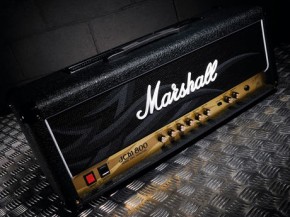
Marshall 2203KK JCM800 Kerry King Guitar Amplifier Head
August 28, 2008 by Chazders · Leave a Comment
When you take the amp that has been the source of pure rock and roll crunch for decades and mix it with one of the most powerful metal guitarists ever to unleash havoc on this planet, what do you get? Read more