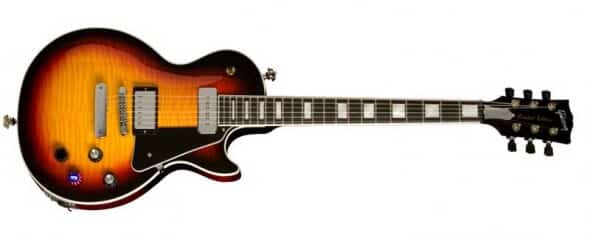
Gibson Dark Fire Electric Guitar
November 13, 2008 by Chazders · Leave a Comment
Gibson’s self-tuning Robot guitar had a limited run; the legendary guitar innovator had a much more insane second stage Robot already blueprinted and hidden up their sleeves. Of course, the mad scientists of Gibson Guitar’s don’t stop there, G-V readers, meet Gibson’s Dark Fire Les Paul digital guitar! Gibson continues to bring us more scientific achievements of our time. Read more

Roland GR-500 Synth-Guitar 1977
The introduction of the Moog Guitar at this past summer’s 2008 NAMM brought to attention of previous attempts to making guitars more synth-like. The Moog Guitar Company didn’t create a guitar synth, per se, but with its features like the voltage-controlled filter and continuous sustain, it’s a prodigy of the Roland GR-500.
The Roland GR-500 was introduced in 1977, which was actually a guitar synth system, with a comparison of an Ibanez-made Les Paul-style electric guitar/controller and a synthesizer design with more than 40 switches, knobs and controls. The Roland used a separate floor unit device, the PC50 footswitch. This unit allowed users to create and select from three different preset sounds. In that era, before MIDI, the GR-500’s components joined together with a bulky 24-pin cable about the diameter of a “garden hose”.
The instrument itself was an impressive looking guitar, with a beautiful honeyburst finish and an extensive knob-encumbered control panel on the top (like Les Paul) and bottom right (like Ibanez) that gave full-control over the synth unit’s four sections: Guitar, Poly-Esemble, Bass and solo-synth section called “Melody”. The guitar had a single humbucker pickup for standard guitar sounds and a hexaphonic pickup that allowed the synth-guitar to track the pitch of each string note with a fair degree of accuracy. In addition, magnets installed within the body allowed the guitar to produce everlasting sustain on demand, though all this added significantly to the instrument’s weight.
So what did the Roland GR-500 sound like? It’s reported that the Poly-Ensemble could produce convincing bowed string sounds, bass tones were effortless, and the synth’s “Melody” section gave guitarists total control over the synth’s components, allowing a complete range of tones, noises and, of course, effects.
The End Line
Roland’s GR-500 is not only unique, but rare, especially complete systems (see: PC50 footswitch and 24-pin cable), which is unfortunate. Without a synth unit and the cable to connect it, the GR-500 guitar is just a guitar.
Buy – Sell – Trade Used Music Gear at GEAR-VAULT CLASSIFIEDS

Gibson’s Robot Guitar Wins Award
October 5, 2008 by Chazders · Leave a Comment
Hail the Gibson Robot Guitar! The Gibson Robot Guitar was awarded with the prestigious “Best Music Hardware Award” at the BT Digital Music Awards 2008. The BT Digital Music Awards now in its 7th year was held at the Roundhouse in London on Wednesday October 1st.
The Gibson Robot guitar is the world’s first electric guitar with robotic technology and beat stiff competition from the Motorola ROKR E8 and Ripserver. The Best Music Hardware Award in association with Stuff Magazine was decided upon by a panel of prominent industry judges. The Gibson Robot Guitar was sighted for its innovation, style, usability and price point among additional features.
The Gibson Robot Guitar is known for eliminating tuning problems for guitarists. The Robot Guitar automatically tunes to standard A440 tuning. In addition, it allows players to access six programmed tuning presets at the push of a button. The Gibson Robot intonates seconds after string changes, truss rod adjustments or change in weather conditions. Ultimately, with the locking tuner, single string changes or changing the entire set of strings is an automated luxury.
The annual Digital Music Awards were presented by TV’s Fearne Cotton and Rufus Hound and was filmed for ITV2. Bands performing in between the awards included Sugababes, Ida Maria, British Sea Power, Sam Beeton, Fightstar and Iglu & Hartly.
Thirteen of the 20 awards given were voted for online and the remaining seven by a panel of industry experts.
Gibson Robots official website: http://www.gibson.com/robotguitar/
Gear-Vault Classifieds is an eBay alternative. Come sell your used guitars and amps with us, for free!

Washburn P3 and DLX Guitars with Buzz Feiten Tuning System
September 15, 2008 by Chazders · Leave a Comment
For all the advancements made in guitar design, one thing has remained essentially the same: try as you might, you can never get the damned things in perfect tune. If an open E chord sounds great, chances are a barred A will sound decidedly less so. Blame it on Pythagoras. Back around 500 B.C., the Greek philosopher and mathematician developed a formula, albeit an imperfect one, for tuning stringed instruments. His formula was popular—so popular, in fact, that it’s still in use today. Which is why your guitar relies on a design that’s about 2,500 years old. Read more

Gibson Firebird Guitar Born 1963
September 6, 2008 by Chazders · 4 Comments
Continued on from “Birth of the Les Paul”
The Gibson Firebird guitar and bass, which came along in 1963, were among Ted McCarty’s final triumphs for Gibson. Read more

Les Paul’s “LOG” Guitar, Circa 1939 - Birth of the Les Paul
Continued from: Les Paul’s journey to Gibson Guitars in 1951
Les Paul’s “LOG” Guitar, circa 1939 is the guitar that came to bear Les Paul’s name. Seeking to develop an up-market alternative to the plain, slab-body Telecaster, Ted McCarty [another towering figure in the early development for the electric guitar] came up with the idea of building a solidbody guitar with a carved maple top or “body cap.” He knew that the Fender factory didn’t have the machinery to do this kind of work. In 1950, McCarty brought this guitar to Les Paul, who approved the design, feeling it was right in line with what he’d been trying to achieve. He reportedly said to his wife and musical partner, Mary Ford, “They’re getting too close to us, Mary. I think we better sign up with them.”
So great were Gibson’s reservations about getting into the newfangland solidbody electric guitar market that the company at one point considered leaving its name off the guitar and just putting Les Paul’s name on. But they plucked up their courage, and in 1952 the first Gibson Les Paul model appeared on the market. It was very similar to the Les Pauls that are around today, with a few key differences. For one, it had a trapeze-style tailpiece. This was a source of some contention between Les Paul and the Gibson company: Gibson wrapped the strings under the tailpiece’s crossbar in order to achieve lower action; Les wanted the strings wound over the crossbar so he could better execute the palm muting technique that became important element of his playing style in the Fifties.
Ted McCarty finally settled the dispute by developing the stop tailpiece, which replaced the trapeze on Les Pauls in 1953. Two years later, McCarty introduced another refinement: the Tune-O-Matic bridge. Both the stop tailpiece and Tune-O-Matic bridge have been staples of electric design ever since.
In 1957, the Les Paul’s original P-90 pickups were replaced by a brand-new invention from a man named Seth Lover. The humbucking pickup featured two coils wound together to cancel out the hum that single-coil pickups generate under fluorescent lighting and in other dodgy electromagnetic circumstances. The humbuckers produced a bass-heavy, “dark” tone which combined with Les Paul’s heavy mahogany and maple body wood and traditional dovetail neck joint to create a distinctly rich tone that would come to be identifiable as “the Gibson sound.”
In the years that followed, Ted McCarty sought to broaden and diversify the essential Gibson aesthetic. Working with a local artist, he developed three revolutionary guitars—the Flying V, the Explorer and the ultra-rare Moderne. Both the Flying V and the Explorer debuted in 1957 (the Moderne apparently never developed past the prototype stage). With their radical angular lines, these instruments were a bit too wild for the late Fifties. Although they didn’t sell well on their initial release, they returned with a vengeance latter in the rock era.
McCarty went in a completely different direction with the Gibson ES-335, the guitar that pioneered the concept of the semi-hollowbody electric. The thin-line body has much less depth than a conventional archtop, which seems bulky in comparison. This significantly reduced the potential for feedback that has always hounded full-sized electric hollowbodies. McCarty also came up with the idea of having a solid block of maple running down beneath the pickups. (The Log revisted!) The result was an instrument—also still very much in use today—that combined many of the best properties of solidbody and hollowbody guitars.
Read more: The Gibson Firebird Guitar and Bass. *coming soon G-V
Gear-Vault Classifieds is an eBay alternative. Come sell your used guitars and amps with us, for FREE!

Les Paul’s journey to Gibson Guitars in 1951
September 3, 2008 by Chazders · 2 Comments
Around the same time that George Beauchamp and the other early electric guitar pioneers were active in southern California, a guitarist and radio personality named Les Paul was in Hollywood working out his own vision of what the electric guitar should be. Born Lester Polfus, he became an established guitarist in the Thirties, performing country music under the names Red Hot Red and, later Rhubarb Red, and jazz as Les Paul. In 1939, Paul began to put together what he called “The Log,” a four-by-four length of solid pine to which he attached a Gibson neck, homemade pickups, a crudely fashioned bridge and vibrato tailpiece. Like many other innovators of the guitar, Paul wanted to eliminate the uneven harmonic response produced by an amplified hollowbody guitar. Although he sawed an Epiphone hollowbody in half and attached the two sides of his four-by-four block of pine, this was more for aesthetic than acoustic reasons—to make the thing look like a real guitar. This supremely quirky instrument, now enshrined in Nashville’s Country Music Hall of Fame, is another sacred relic of the electric guitar’s evolution, the product of an inveterate tinkerer and one of the century’s most original musical inventors. Paul also pioneered multitrack recording and anticipated the home recording boom by a good 30 years.
Paul used the Log on recordings he and his trio made with Bing Crosby, the Andrews Sisters and others. But when he brought the instrument to Gibson’s headquarters in Kalamazoo, Michigan, in 1941, they laughed at him. “I took the Log to Gibson and I spent 10 years trying to convince them that this was the way to go,” recollects Les. “But it wasn’t easy. If it wasn’t for Leo Fender, I don’t think that ever would have come off. Leo saw more in it that Gibson did.”
True enough. A venerable company, with origins tracing back to the 19th century, Gibson had taken a conservative, classicist approach to the electric guitar, producing electric archtop hollowbodies like the ES-150, which was introduced in 1936 and adopted by jazz players like Charlie Christian. Other “old school” manufacturers like Epiphone, Harmony and Kay had taken a similar tack. But with the huge success of the Fender Telecaster in the early Fifties, Gibson decided to “go California” and get in on the solidbody market. Suddenly Les Paul’s Log didn’t seem like such a crazy idea. “Better go get that kid with the broomstick,” someone at Gibson is purported to have said.
The man who made it happen was Ted McCarty. A shrewd businessman with a good eye for design and a flair for building teams of like-minded visionaries, McCarty is another towering figure in the early development of the electric guitar. Originally a buyer for Wurlitzer, McCarty joined Gibson on 1948, and in 1950 he was made president of the company. It was McCarty who oversaw the design of Les Paul’s “LOG” Guitar. http://www.gibson.com/
Gear-Vault Classifieds is an eBay alternative. Come sell your used guitars and amps with us, for FREE!

Godsmack Smack Attack
August 27, 2008 by Chazders · Leave a Comment
Who says you need a big budget, a hotshot producer or a fancy, gazillion-track studio to make a hit record? Not Godsmack, a Boston-based band that sounds more like Seattle (their name actually comes from an Alice in Chains song). Godsmack’s selft-titled major label debut originated as a self-produced demo recorded back in 1996 for just $2,500—which the band had to borrow from a friend. Read more

Epiphone EM-2 Prophecy EX Guitar
August 16, 2008 by Chazders · Leave a Comment
Much like Squire and Fender, Epiphone and Gibson are considered by some to be worlds apart in terms of quality. While this could usually be the case when comparing a lower end Epiphone and a higher end Gibson, it’s not always the case when you compare a $300 Epiphone and a $1000 Gibson. The EM-2 Prophecy EX guitar falls into this $300 range, but how does it compare to guitars in the same price range and even Gibson guitars that cost more?
Main Product Features
Epiphone now makes two different EM-2 Prophecy guitars: the Prophecy FX and EX. While the FX comes standard with a Floyd Rose tremolo, the EX comes with LockTone Tune-O-Matic stopbar. The LockTone bridge provides stable tuning much like the original Floyd Rose stays in tune, so it’s a great choice for guitarists who rock their guitar hard.
Appearance: the EX is comparable to the FX. It features the same Swept-C cut-away body shape, the same hard maple neck, the same blade inlays, the same white binding, and Grover tuning pegs. Where it differs is the color and bridge of the guitar. The EX features a sapphire blue design with black EpiActive pickups and pearl control knobs.
The guitar features 24-frets with a design that allows access to every single fret. While higher fret soloing on a Les Paul is difficult, it is ridiculously easy with the EX prophecy. It’s for this reason that the EX is an ideal guitar for fans of both metal and modern rock—two styles of music that use quite a bit of 24-fret soloing.
Like the FX, the EX comes with EpiActive pick-ups which, combined with the bound basswood body, give the guitar a very nice, rich, yet flexible sound.
While the EX is by no means an flawless guitar—and doesn’t provide the sound and playability as guitars priced a 3 – 4 the price—it does hold up well when compared to guitars in the $300 price range and, perhaps, beyond.
Go to your local guitar shop and take one for a spin.
Gear-Vault Classifieds is an eBay alternative. Come sell your used guitars and amps with us, for FREE!

Epiphone Prophecy EM-2 FX Guitar
August 12, 2008 by Chazders · Leave a Comment
While we all know Gibson and Epiphone are both well-known for their SG and Les Paul guitar-style, however, what makes Prophecy EM-2 extraordinary, is the construction of the “swept-C” body-style. Interesting enough, the guitar looks more like an axe made hybrid by Schecter and Steinberger (Steinberger is a division of Gibson). The Prophecy EM-2 FX is a guitar with an edge-cutting design manufactured by Epiphone.
Main Product Features
At first glance, I noticed the Epiphone Prophecy EM-2 FX comes in a very tempting color: Midnight Ebony Quilted Maple Top. The tops are flawlessly chosen to give the finish a beautified swirled look. The EM-2 is crowned off with white binding that goes around the top-edge of the body.
The guitar has mixed-color hardware—the tuning pegs, tremolo bar and pick-up selector are black, while the control knobs are silver, which enhance the beauty of the ‘blade’ inlays.
Another thing that is impressive about the EM-2 guitar is that, despite being very modestly priced, is that it features high quality hardware. Every FX guitar comes standard with an Original Floyd Rose tremolo system and Grover Tuners, giving the guitar rock n roll flexibility, while vigorously holding tune.
All FX guitars come with authentic EpiActive humbucker pick-ups. EpiActive pick-ups are now being commonly used in recent Epiphone guitars, and are considered to be on par with EMG pick-ups. In addition, EpiActives can also be used in passive mode to provide a traditional output without the need for a battery.
The EM-2 body-style screams rock n roll - achieved with Epiphone’s patented “swept-C” cutaway that gives you comfortable access to all 24-frets, which you’ll be thankful for when you crank up the volume and start soloing. In fact, Epiphone actually made the first EM-2 styled guitars back in the early 90s when Grunge was the frenzy, and this EM-2 Custom FX features the same dedicated reverse Explorer-style headstock as its bona-fide-brothers.
END THOUGHT
The Epiphone Prophecy EM-2 FX is a solid guitar, high quality components, and great playability, all for a very modest price tag of $399. Go test drive one for yourself, you won’t be disappointed.
Gear-Vault Classifieds is an eBay alternative. Come sell your guitars and amps with us, for FREE!