
Lindert Baritone Guitars
September 19, 2009 by Chaz · Leave a Comment
If you’ve never come across a Baritone guitar, you could be forgiven for being confused by them. Just where do these long-necked axes with six fat-ass strings fit in? The actually live somewhere between a bass and a standard six-string, relating to those instruments much like a viola correlates to the cello and violin. The Fender Bass VI, designed by Leo Fender and introduced in 1961, is often considered the first commercial electric baritone. In actuality, the Bass VI is a short-scale six-string bass, tuned an octave lower than a guitar, with closer string spacing than a standard bass. True baritone guitars are tuned somewhat higher than a bass guitar, with actual tuning determined by their scale, and their use of lighter gauge strings make them easier to play than basses. And in fact, the tow guitars reviewed here demonstrate the results of different scale lengths and tuning within the baritone family. Read more
Fender Custom Shop Esquire Guitar
August 6, 2009 by Mike O'Cull · Leave a Comment
The Fender Telecaster is seen by many as the primordial electric guitar. It is brutally simple and to the point, built for functionality, and tends to appeal to the caveman contingent of the guitar community, of which your humble Gear-Vault scribe proudly considers himself part. What a lot of players forget is that there is a Fender guitar that is even more stripped-down than the Tele, one that makes Teles seem like Cadillacs. That guitar would be the Fender Esquire. Read more
Leo Fender and Marshall Amplifiers – Beginning of the Guitar Amp
September 8, 2008 by Chaz · Leave a Comment
Continued on from “Gibson Firebird Guitar Born 1963”
Of course the electric guitar wouldn’t have developed at all had it not been for amps. And the guitar amplifier would never have come into being had it not been for Mr. Lee De Forest, who invented the vacuum tube Read more
Les Paul’s journey to Gibson Guitars in 1951
Around the same time that George Beauchamp and the other early electric guitar pioneers were active in southern California, a guitarist and radio personality named Les Paul was in Hollywood working out his own vision of what the electric guitar should be. Born Lester Polfus, he became an established guitarist in the Thirties, performing country music under the names Red Hot Red and, later Rhubarb Red, and jazz as Les Paul. In 1939, Paul began to put together what he called “The Log,” a four-by-four length of solid pine to which he attached a Gibson neck, homemade pickups, a crudely fashioned bridge and vibrato tailpiece. Like many other innovators of the guitar, Paul wanted to eliminate the uneven harmonic response produced by an amplified hollowbody guitar. Although he sawed an Epiphone hollowbody in half and attached the two sides of his four-by-four block of pine, this was more for aesthetic than acoustic reasons—to make the thing look like a real guitar. This supremely quirky instrument, now enshrined in Nashville’s Country Music Hall of Fame, is another sacred relic of the electric guitar’s evolution, the product of an inveterate tinkerer and one of the century’s most original musical inventors. Paul also pioneered multitrack recording and anticipated the home recording boom by a good 30 years.
————————————————————
Paul used the Log on recordings he and his trio made with Bing Crosby, the Andrews Sisters and others. But when he brought the instrument to Gibson’s headquarters in Kalamazoo, Michigan, in 1941, they laughed at him. “I took the Log to Gibson and I spent 10 years trying to convince them that this was the way to go,” recollects Les. “But it wasn’t easy. If it wasn’t for Leo Fender, I don’t think that ever would have come off. Leo saw more in it that Gibson did.”
True enough. A venerable company, with origins tracing back to the 19th century, Gibson had taken a conservative, classicist approach to the electric guitar, producing electric archtop hollowbodies like the ES-150, which was introduced in 1936 and adopted by jazz players like Charlie Christian. Other “old school” manufacturers like Epiphone, Harmony and Kay had taken a similar tack. But with the huge success of the Fender Telecaster in the early Fifties, Gibson decided to “go California” and get in on the solidbody market. Suddenly Les Paul’s Log didn’t seem like such a crazy idea. “Better go get that kid with the broomstick,” someone at Gibson is purported to have said.
The man who made it happen was Ted McCarty. A shrewd businessman with a good eye for design and a flair for building teams of like-minded visionaries, McCarty is another towering figure in the early development of the electric guitar. Originally a buyer for Wurlitzer, McCarty joined Gibson on 1948, and in 1950 he was made president of the company. It was McCarty who oversaw the design of Les Paul’s “LOG” Guitar. http://www.gibson.com/
Gear-Vault Classifieds is an eBay alternative. Come sell your used guitars and amps with us, for FREE!
Leo Fender Precision Bass invention 1951
September 2, 2008 by Chaz · Leave a Comment
Contined on from Leo Fenders invention Broadcaster Article.
The electric bass guitar was another Leo Fender invention that changed sound of 20th century popular music. It supplanted the upright bass fiddle in rock, country and many other genres. Essentially, Leo reconceptualized the bass fiddle as a low-pitched electric guitar, far more portable and manageable on stage than a bulky upright, and capable of greater volume levels. Fender called his creation the Precision Bass when he introduced it to the world in 1951 because, unlike the upright, it was a fretted instrument, which allowed the player to hit notes with truer intonation, i.e., greater precision.
Read more on Leo Fender’s first Stratocaster produce in 1954.
Gear-Vault Classifieds is an eBay alternative. Come sell your used guitars and amps with us, for FREE!
————————————————————
Leo Fender & George Fullerton introduced Broadcaster – Telecaster 1950
September 1, 2008 by Chaz · 3 Comments
The 20th century will be remembered as an age of technology. And the electric guitar has been one of the most benign technologies to emerge from our troubled outgoing century. Like the innovations of Thomas Edison or Henry Ford, the electric guitar is a great populist invention. Read more
The life of Leo Fender
August 15, 2008 by Chaz · Leave a Comment
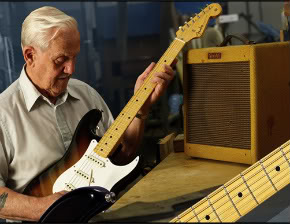
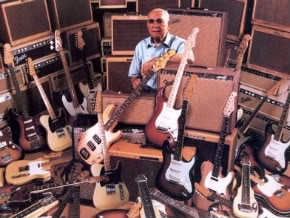
Before Leo Fender came along, the solidbody electric guitar was little more than a gimmick. No other person did as much to develop this “gimmick” into one of the most important musical instrument of the 20th century.
Born in 1909 on a farm in Anaheim, California, Clarence Leo Fender opened a radio repair shop in nearby Fullerton in the years just after Word War II. He gradually segued into building electric guitars and amplifiers, and launched the company that bears his name in 1948.
In the years between 1948 and 1954, Leo Fender designed the Telecaster (the world’s first successful mass-produced solidbody electric guitar), the Precision Bass (the world’s first electric bass guitar) and the Stratocaster (for many, the world’s coolest electric guitar). These instruments embodied a design aesthetic that broke radically with tradition. Products of the post-WWII age of mechanization, they were affordable yet elegant tools for the average-income musician.
The Tele, P-Bass and Strat, along with Leo Fender’s tube amplifier designs, made their appearance just as a brand new style of music called rock and roll was being formulated. They became and integral part of rock’s sound, and have been taken up by major players from every subsequent rock generation, as well as guitarist in many other musical genres.
————————————————————
Leo helmed the design of the Jazzmaster (1958), Jaguar (1962) and many other classic Fender models before selling the company to CBS in 1965, citing ill health as his reason for doing so. By 1971, he was back in action, however, as head of a new company, CLF, designing amplifiers for MusicMan and guitars for G&L, further developing and refining the “Leo Fender style.”
A down-to-earth and highly industrious man, Fender left behind a prodigious legacy when he succumbed to complications associated with Parkinson’s disease on March 21, 1991. He was laid to rest at Fairhaven Memorial Park in Santa Ana, California.
Gear-Vault Classifieds is an eBay alternative. Come sell your used guitars and amps with us, for FREE!