Jimi Hendrix Guitar Tutorial DVDs
September 28, 2009 by Chaz · Leave a Comment
Press Release–one of the world’s biggest suppliers of guitar tuition DVDs, has just released a comprehensive series of Jimi Hendrix guitar tuition DVDs. These are essential for guitar players of all standards.
Widely considered as the greatest guitarist in the history of rock music, Jimi Hendrix was one of the most important and influential musicians of his era. The mere mention of his name will start many guitarists finger picking. His raw talent and creativity defined some of the most revolutionary music of the 20th Century, taking guitar playing to another level. For many though it was simply his ability to express raw emotion though music. Read more
Gibson to create Strats for Jimi Hendrix’s new Signature Model?
September 18, 2009 by Chaz · 7 Comments
Did the title get your attention? Good. According to an interview conducted with Jimi’s younger sister, Janie Hendrix, Gibson is going to create the new Jimi Hendrix Signature Model. Update: Confirmed. Gibson did knock off a Fender Strat-Style guitar and calling it a “Hendrix Electric Guitar Package“. Read this post: People are outraged at Gibson.
How do they plan to do that? Jimi’s main axe which he played live and in studio was usually a Fender Stratocaster. Remember back in 1967 when Hendrix’s first alight a guitar-on-fire-stunt. He famously golfed his Fender Stratocaster in lighter fluid and set it ablaze. Read more
BIG MUFF: History of the EHX Big Muff
September 17, 2009 by Chaz · Leave a Comment
In the beautiful city of New York, the Big Muff, which acts as a guitar pedal that can distort fuzz sounds, became very well-known. The Muff was created, introduced and manufactured by Electro-Harmonic Company (EHX) together with its sister company, the Russian Sovtek. Primarily the Big Muff was used for electric guitars but later bass guitars also were able to make use of such a powerful yet tiny machine. The Big Muff guitar pedal was invented by Mike Matthews and introduced in the early 1970s. Carlos Santana and David Glamour were the two artists who first used this guitar pedal. Read more
Jimi Hendrix – The Greatest Electric Guitarist
August 20, 2009 by Chaz · 5 Comments
Jimi Hendrix was given the top spot–According to the readers of Time Magazine, Jimi Hendrix was voted the greatest electric guitar player of all time. Read more
Fight Club: Jimi Hendrix vs. Stevie Ray Vaughan
August 2, 2009 by Mike O'Cull · 8 Comments
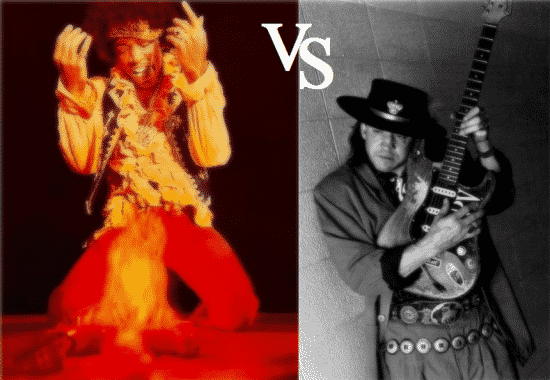
Two of the most revered guitar players in the blues/rock universe are Jimi Hendrix and Stevie Ray Vaughan. Both men helped define the sounds of their respective eras and are icons of the instrument and are most likely responsible for launching more guitar-playing careers (both real and air) than any post-Beatle guitarist outside of Eddie Van Halen. Today, however, your humble man of letters here at Gear-Vault has been given the difficult task of pitting Jimi and SRV in a head-to-head battle for musical supremacy, which is truly no easy task. In the flyover, both man share many similar qualities, from their explosions into public consciousness to their preference for Fender Stratocasters to their untimely deaths. When examined more closely, however, there are some major differences between the two that just might give one the edge over the other. Want to watch the fur fly? Keep reading. Read more
Top Ten Must – Know Rock Guitar Riffs
June 16, 2009 by Mike O'Cull · 23 Comments
The guitar riff is central to rock and roll as we know it. A great intro riff identifies and emboldens a song and kicks the band (and the crowd) into overdrive. Rock history is filled with riffs that have changed the world and it is all of our jobs to learn to play as many of these as we can. That’s how we learn what greatness really is and how we absorb the vocabulary needed to craft our own riffs and songs. Read more
Fender Squier Stagemaster with Floyd Rose Floating Tremolo
February 23, 2009 by Chaz · Leave a Comment
Squier Stagemaster is a uniquely different tailor of the typical Fender Stratocaster guitar. The Squier Stagemaster is made explicitly for the rocker players alike. With its sleek Strat body design, reverse Fender-shaped headstock and its drive-bombing License Floyd Rose double-locking tremolo system, the Stagemaster spells “flash” with all of its humbling features.
Much like Fender’s Fat Strat, the Stagemaster guitar is equipped with a lustrous hardwood body, smooth-shredder-fast maple neck. The neck is much thinner than the typical C-shaped Stratocaster and with its reverse headstock, the guitar has appeal and zazz. Playing it feels like Jimi Hendrix’s reversed Stratocaster; for his left hand playing–however, the Stagemaster is a right hand guitar. Whats more, the Stagemaster is equipped with a solid Rosewood fingerboard (12.6″ radius) and 22 frets. The die-cast machine head tuning pegs are what you’d expect from a guitar with Fender‘s name on it. The pickups are a bit bland, but certainly not bad for a guitar in this price range. The pickups are managed with its 5-way selector switch, master volume and a single tone control.
—————————————————————
The Squier Stagemaster, in a way, reminds me of a low-line version of Dave Murray’s [guitarist of Iron Maiden] 1957 Stratocaster. Dave Murray notoriously used his ‘57 Stratocaster back in the late 70’s through the 80’s. Like the Stagemaster, his 1957 Strat was equipped with a Floyd Rose double-locking tremolo system, HSH pickup configuration and a maple neck with a rosewood fretboard . However, his legendary Strat did not have a reverse headstock or a thin (fast) design-neck-shape. His guitar was black with a white pick guard (not to mention, Dave replaced the original Fender pickups with DiMarzio humbuckers to “fatten up the sound“).
The Stagemaster, though no longer in production [info that we can find is the last year made was 2001], was available in three different pickup configurations. The Stagemaster HSS features a scorching humbucker in the bridge position and two hot single-coils in the middle and neck with 5-way switching. While the HH features dual humbuckers and 3-way switching, and last but not least, the HSH has dual humbuckers and one single-coil pickup in the middle. The color options for the Fender Squire Stagemaster was: Frost Red, Polar White, Cobalt Blue Metallic, balck and Galactic Purple.
A guide to vintage British amplifiers
January 4, 2009 by Chaz · Leave a Comment
I’ve been interested in vintage American amplifiers for a long time. But recently, while surfing on the internet, my curiosity for classic British amplifiers was piqued. While practically everyone knows about Marshalls and Voxes, I’ve found some amp lines—like Selmer and Watkins and a few others from the Sixties—that are relatively obscure here in America. I’d like to know what some of these amps sound like and what well-known players have used them. Can you suggest any reference or resource materials that can give me information about these mysterious amps?
-Mikey
xxx@gmail.com
Dude, you are in luck! A friend recently sent me a totally cool CD from the U.K. called Ampaholics, The Vintage Collection—Volume One. Compiled by a British amp enthusiast over a two-year period, Ampaholics is a virtual “tone dictionary” of what 17 pre-1970 British amps sound like. Each amp is recorded “flat”—with no eq—to give you the purest and most accurate representation of what these amps made famous by Clapton, the Beatles, Jimi Hendrix, the Who and others sound like.
————————————————————
The CD comes with a handsomely designed 20-page booklet filled with historical and tonal information written by David Petersen, an authority on Vintage British amplification, and accompanied by high-quality photographs of such classics as the 1965 VOX AC30 top boost, 1968 Marshall JMP50 “plexi,” 1966 Marshall Blues Breaker combo and 1961 Watkins Dominator, to name a few.
As you listen to the CD, a “guide” announces each amp and tells how it’s being used (i.e, “1960 Vox AC15 1×12, at full volume,” “…with guitar in the middle pickup position,” etc.). In addition, each amp is represented by three or four examples that use different volume and tone settings. Ampaholics is unique in that it’s a valuable reference tool for beginning and pro guitarists, producers, vintage amp collectors, music retailers and general enthusiasts of music memorabilia (i.e., Beatles freaks).
And when you consider that the opportunity to hear and familiarize yourself with this many classic tones is a privilege and luxury typically enjoyed only by successful recording artists and producers, the advantages of having this CD makes a lot of sense when you’re an ampaholic!
BB-2 Bluesbreaker II Marshall Stompbox
October 19, 2008 by Chaz · Leave a Comment
Modeled after Marshall’s original Bluesbreaker pedal, the BB-2 offers two modes instead of one. The unit’s clean, but merciless boost function can pummel an amp’s input stage or drive long cables without altering the tone of your guitar, while the blues mode uses the pedal’s drive and tone controls to create a wide range of valve-like overdrives rich in 2nd-order harmonics.
The BB-2 worked extremely well with a vintage Marshall Super Lead, producing no low-end loss when interacting with the amp’s power tube distortion. It’s performance was equally commendable with a blackface Fender Princeton, where the BB-2’s ultra-musical crunch was plainly in evidence.
————————————————————
The End Line
The BB-2 Bluesbreaker is a great pedal. The blues feature delivers nice, smooth drive which allows for singing highs and roaring lows. The boost feature is a bonus considering the cost of this pedal. The boost feature delivers a nice clean “BOOST” to your signal, which can be used for soloing on an already distorted amp.
I was also impressed by the fact that the BB-2 got in Hendrix like “fuzzy” territory, simply by using the blues function with the amp setting just a tad bit dirty. I use the BB-2 coupled with my crybaby classic and, I must say, that doubled the Hendrix vibe.
Overall: Wonderful Pedal I would recommend it to anyone that likes the blues but also want that extra “BOOST”.
I wouldn’t recommend this pedal with solid state amps.
The Marshall BB-2 Bluesbreaker II can be had at a very reasonable price at MusiciansFriend.com.
Find – Buy – Sell – Trade
Used Music Gear
Gear-Vault Classifieds
How Does A Wah-Wah Work?
October 16, 2008 by Chaz · Leave a Comment
Way back when electric guitars were still new fangled a few country players found they could add accents and expression to their music by twisting the guitar’s tone control while they played. Although subtle and somewhat tricky to negotiate, this maneuver produced a shift between muted bass and bright treble, adding color and movement to the notes.
The wah-wah pedal is based on a simple concept but its effect is far more dramatic. Using a powerful filter to sweep through a broad frequency spectrum, the wah pedal boosts and exaggerates specific tones. Creating sounds that range from thick, flubbery bass to scratchy, stinging treble. The further forward the pedal is pushed the higher the boosted frequencies, resulting in expressive, and vowel like tones.
Although Ampeg was experimenting with a wah pedal as early as 1961, Vox was the first to create a commercially viable product. In the mid-sixties, Brad Plunkett, an engineer at Thomas Organ, was working on a circuit to replace the traditional three position tone switch with a less expensive potentiometer.
On the advice of a fellow engineer, Plunkett based his design on the circuitry of an oscillator. Plugging in guitar to test his new device his ears were greeted with the extreme almost vocal sound of the world’s first wah-wah.
————————————————————
Vox immediately saw potential in the new device. Ironically the company has been accepted by a trumpet player named Clyde McCoy who had asked for a device that could emulate the tone of a trumpet mute being opened and closed. As a result, the commercially available wah-wah was sold as the Clyde McCoy Wah-Wah Pedal and even bore McCoy’s image on the base plate. In 1968 eager to differentiate its product from competing brands in the US Vix slapped the name Crybaby on its model. Soon afterward the pedal was adopted by Jimi Hendrix and the rest as they say its history.
During four decades of service, the wah-wah circuit has appeared in various forms. But whether produced by Morley, Snarling Dogs, Jim Dunlop or Digitech, all wah-wah pedals are simply variations on Plunkett’s original theme.
Find – Buy – Sell – Trade at Gear-Vault Classifieds