T-Rex Twister Chorus/Flanger Pedal
October 29, 2008 by Chazders · Leave a Comment
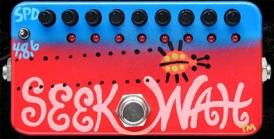
T-Rex introduces the latest member of the stomp box family of effects named, the Twister. The Twister contains both flanger and chorus in one single rugged box, which makes it an outstanding choice for guitarists!
Flanger and Chorus are two all-time classic effects that are so closely related that a single stomp box can produce them both. T-Rex wanted to give you both great effects in a single pedal. While the chorus produces a compelling sparkle and shine to your sound, the flanger puts a funky blend on both single-notes and chords. Hear it for youself, and you’ll discover how it’s the wild and unusual effect you’ve been longing for.
The Twister is packed with features that make sure that you get the chorus or flange blended just the way that you want. What’s more, the Twister has a mono output for running through an amp on stage, and stereo outputs for the studio and live stereo situations. In chorus mode, the light/heavy switch allows you to quickly toggle between two classic variants of the chorused sound, while the tone control allows you take off some of the top for a more subtle effect. And rest assured: like every pedal T-Rex makes, The Twister not only sounds phenomenal, it’s extremely rugged.
T-Rex Twister specifications:
* Input Impedance @ 1KHz: 464KOhm
* Output Impedance@1KHz : 370hm
* Power supply: 9V DC (Power tool 9)
* Minimum Power supply Voltage: 8,5V DC
* Maximum Power supply Voltage: 12,5V DC
* Current Draw @ 9V DC: 81mA
* Maximum input signal Vp/p: Adjustable
* Battery Type: 9V battery 6F22
* Battery Life: 1/2 to 1 Hour
* External connectors: Input Jack. Output Jack (L), Output Jack (R), 9V DC jack
* Controls: On/Off, Level, Depth, Regen, Tone, Rate, Chorus/Flanger, Light/Flanger
* Depth: 120mm
* Width: 100mm
* Height: 55mm
* Weight (excl. battery): 0,430Kg
Visit their official web site at www.t-rex-eng.com.
Buy – Sell – Trade Used Music Gear at Gear-Vault Classifieds

Fernandes Nomad Deluxe
October 22, 2008 by Chazders · Leave a Comment
With its Nomad Standard, Fernandes managed to pack a speaker and five-watt amp into a tiny, bean-shaped guitar body. Designed as a self-contained electric travel guitar, the Nomad Standard offered all the benefits of full-size models in a compact and portable package.
Fernandes must have a miniaturized ray in its factory, because the Nomad Deluxe manages to add on a 24-patch effects processor and an auto-chromatic guitar tuner. The result could be the world’s most versatile travel guitar—one that can easily make the transition from bedroom to studio to stage.
The Nomad’s body (what little there is of it) is machined from hardwood laminate. In addition to being cleverly shaped to hug your knee, the body balances perfectly well for strap-on action. The bolt-on neck features some substantial, tidy frets as well as a headstock that could have been designed by the cartoon-making folks over at Hanna-Barbera. You’ve got to appreciate a peghead so blobulent that it leads the whole guitar a unique wide-angle, baby elephant look. Planted along its fat curves are some solid sealed machine heads and an accurately filed graphite nut.
The Nomad’s 24 factory effects presets offer a rack’s worth of multi-dimensional sounds ranging from brutal to ambient. Among the many effects are chorus, compression, delay, distortion, doubling, flanging, fuzz, reverb, overdrive, wah, phasing, pitch-shifting, eq, amp emulations and even an acoustic guitar simulator. An easy-to-read LED shows which bank, patch and effects are active, and a handful of switches are provided to help scroll, edit and store patches and effects parameters.
It only takes a few minutes to get familiar with the system and its editing process. Up to nine of the 24 effects can be used at once and stored in any of the 24 patches. Simply select a preset, press the edit button and move sequentially through the seven effect blocks. Each block allows you to scroll through a series of preset parameters (all of them clearly tabulated in the manual) and select the one best suited to the tone you want to create. After tweaking through the chain, you can store the results. Should you ever decide to revert to the original factory presets, a few simple maneuvers will return the multi-effects unit to the factory specifications.
Although the Nomad Deluxe features a built-in speaker from which to blast its effects, the guitar also has an output jack that gives you the option of listening in private via headphones or plugging the Nomad into an amp. A second jack allows you to hook up a footswitch for hands-free bank switching, or an expression pedal to make full use of the wah and pitchshifting effects. And because the Nomad Deluxe is, in essence, a travel guitar, Fernandes has equipped it with onboard 9-volt power. They’ve also quite thoughtfully provided an AC-adaptor socket (adapter included), for those moments when you run out of batteries.
Despite its dinky dimensions, the Nomad Deluxe has easy action and a full-scale neck, allowing it to play an easily as any full-bodied electric. Both liberating in its portability and inspiring in its wealth of effects, the Nomad Deluxe is one outspoken little axe that could well make you a one-man Lollapalooza at your next barbecue.
The Fernandes Nomad Deluxe can be had at a very reasonable price at MusiciansFriend.com.
Find - Buy - Sell - Trade
Used Music Gear
Gear-Vault Classifieds

BB-2 Bluesbreaker II Marshall Stompbox
October 19, 2008 by Chazders · Leave a Comment
Modeled after Marshall’s original Bluesbreaker pedal, the BB-2 offers two modes instead of one. The unit’s clean, but merciless boost function can pummel an amp’s input stage or drive long cables without altering the tone of your guitar, while the blues mode uses the pedal’s drive and tone controls to create a wide range of valve-like overdrives rich in 2nd-order harmonics.
The BB-2 worked extremely well with a vintage Marshall Super Lead, producing no low-end loss when interacting with the amp’s power tube distortion. It’s performance was equally commendable with a blackface Fender Princeton, where the BB-2’s ultra-musical crunch was plainly in evidence.
The End Line
The BB-2 Bluesbreaker is a great pedal. The blues feature delivers nice, smooth drive which allows for singing highs and roaring lows. The boost feature is a bonus considering the cost of this pedal. The boost feature delivers a nice clean “BOOST” to your signal, which can be used for soloing on an already distorted amp.
I was also impressed by the fact that the BB-2 got in Hendrix like “fuzzy” territory, simply by using the blues function with the amp setting just a tad bit dirty. I use the BB-2 coupled with my crybaby classic and, I must say, that doubled the Hendrix vibe.
Overall: Wonderful Pedal I would recommend it to anyone that likes the blues but also want that extra “BOOST”.
I wouldn’t recommend this pedal with solid state amps.
The Marshall BB-2 Bluesbreaker II can be had at a very reasonable price at MusiciansFriend.com.
Find - Buy - Sell - Trade
Used Music Gear
Gear-Vault Classifieds

Korg D8 Digital – Analog Recorder Review
September 26, 2008 by Chazders · 2 Comments
The fun started with the Korg D8, which is by far the smallest of the three recorders I sampled for this series of reviews. In fact, if you weren’t looking at it too closely, you might mistake it for a drum machine rather than a portable eight-track studio. Its appearance, however, is deceptive, for inside the D8 is a 1.4 GB hard drive, which allows a maximum of 34 minutes of eight-track recording. Read more

The Gibson Holy V Guitar - Only 1000 Being Made
July 26, 2008 by Chazders · Leave a Comment
Having come up with such guitars as the Les Paul and Flying V, among others, Gibson is known for innovation, creativity and spirit. The Gibson Holy-V is a representation of this continuing ingenuity, with its unique body and headstock. Like most Gibson guitars of the month, January 2009—is Gibson’s latest testament to their imagination. Production is quite limited—just 1,000 of these are being made, making it both a collector’s item and a good guitar for both the amateur and the pro guitarist.
The Main Features
One of the most noticeable things about the Holy V is the holes (vented openings) that are found in the V-shaped body and headstock of the guitar. These holes are carefully carved into the body and the headstock, so as to make the guitar the lightest Gibson to date and gives an intense aesthetic effect. Indeed, the guitar has the same tonal sound quality of a traditional Gibson Flying V, while it’s said that the vented cavities provide for more sustain, we should all agree that the light weight creativity is a unique feature in itself.
Another thing people will notice about the guitar is the gearless tuners. There are no tuning pegs on the headstock, which gives the headstock a very distinctive look. Every Holy V is fitted with Steinberger Gearless Tuners which are noted for their smooth tuning action and accuracy and are said to prevent string slippage.
The Gibson Holy V also features a 24-fret ebony fingerboard, making it ideal for guitarists who need the extra two frets for soloing. While the Flying V is usually considered to be a guitar appropriate for metal/hard rock guitarists, the Holy V can handle many types of music. So if you’re a classic rock or modern rock guitarist, you’ll still find something to like about this guitar.
Among the Holy V’s other features are the beautiful split diamond inlays, a mahogany set-neck construction (for better sustain), solid mahogany body with a Tune-O-Matic bridge and a ‘57 classic pickup, supplying the classic Gibson PAF crunch and power.
While the Holy-V is an expensive guitar, for all that it features and uniqueness; is worth it?
MSRP $2799 but can be found as low as $1839. The Gibson Holy-V will not be available until January 2009. However some music stores will allow you to pre-order.
Gear-Vault Classifieds is an eBay alternative. Come sell your used music equipment with us, for FREE!

DEAN ZELINSKY: I Can No Longer Attach My Name To Quality And Direction Of DEAN GUITARS
July 23, 2008 by Chazders · 17 Comments
Today Gear-Vault received information that Dean Zelinsky, founder of Dean Guitars, announced that he has parted ways with Dean Guitars, the company that he founded in 1977. Read more

Gibson ES-135 Limited Edition Guitar Review
July 22, 2008 by Chazders · Leave a Comment
With its single cutaway and slightly deeper body (2.125 inches at the edge), the ES-135 comes a little closer to a jazz axe than its 335-based brothers. Read more

What’s Tremolo and how does it work?
July 22, 2008 by Chazders · Leave a Comment
Tremolo suffers from an acute identity crisis. Thanks to various descriptive errors made in the Fifties, tremolo is frequently mistaken for vibrato. For the record, tremolo is a rhythmic pulse produced by a change in volume over a set clock rate; Read more

Story of the Instruments Strings
July 21, 2008 by Chazders · Leave a Comment
The very utterance of the word ‘guitar’ conjures a series of varying and fleeting images in one’s mind. Though mostly associated with the long haired, head banging rock stars, guitar also conveys or signifies various other connotative meanings as well, mostly above all the Freedom of Expression. Despite the fact that this string instrument in the modern times is perceived as a symbol of articulation of free thoughts, it has been now confirmed that guitar has its history and origin sometime in the first century in the Roman Civilizations.
In spite of its germination in first century, it was not until around 1200 AD that this instrument started resembling its present day counterpart in terms of the shape, appearance and functioning, for the first time and this feat is generally credited to the Hispanics, Moors and the Norse. The saga of the modern day guitar more or less starts with Gaetano Vinaccia, a resident of Naples who lived in the mid 18th and early 19th century. Another set of important names that have been historically associated with vintage guitars are those of Antonio Torres Jurado and Louis Panormo, both having significant contributions in the make or construction of the instrument. All these were howbeit, facts related to the traditional, classical acoustic guitar. It was George Beauchamp of Texas, USA along with Adolph Rickenbacher of Switzerland who jointly founded the guitar manufacturing company “Rickenbacher” and patented Electric guitars; though the mass production was first started by “Danelectro”.
The chronicles of vintage electric guitars witnessed an era of emergence and development of various new ideas in terms of style, design, etc. in and around the time of the Second World War. One of the pioneering names from this period is that of American jazz guitarist and inventor Les Paul. Among his groundbreaking contributions are those of striking the correct balance with a pickup, bridge and neck of a guitar leading to the solutions of problems involving the sustaining and feedback of sound. He also experimented with the effects such as phaser and delay and made important innovations which were to be popularized by musicians in decades to come. His model of guitar, manufactured by Gibson Guitar Corporation became known as the “Gibson Les Paul” and went on to become one of the most familiar instruments in different genres like jazz, blues, rock, metal and have been associated with figures like Jimmy Page, Jeff Beck, Gary Moore, Slash, Adrian Smith and Ted Nugent among others.
The only other name that appears in the same row as Les Paul in the story of vintage guitars is that of Leo Fender of USA. His model of “Esquire” and “Broadcaster” (later changed to “Telecaster”) was nearly synonymous with early popular music like boogie woogie, R&B, swing, honky tonk, etc. It was however with “Stratocaster”, launched in the early 1950s, that he struck gold. With its solid body and bolt-on neck joint, the very name invoke names of its eminent users including Jimi Hendrix, Eric Clapton, Ritchie Blackmore, David Gilmour, Buddy Guy, Robert Cray to mention a few.
Gear-Vault Classifieds is an eBay alternative. Come sell your music equipment with us, for free!

Epiphone Riviera Semi Hollow Body Electric Guitar Review
July 21, 2008 by Chazders · 2 Comments
The Riviera is a perfect example of Epiphone’s ability to rival parent Gibson in quality and playability. It’s a kissing cousin to the Gibson ES-335, set apart by its mini-humbuckers and “Frequensator” tailpiece. Read more