
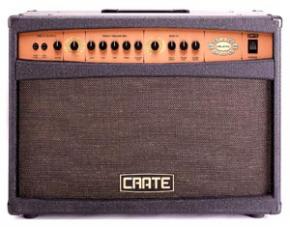
 With its brushed copper front panel, big black knobs and jellylike, illuminated keypad, Crate’s digital DX-212 looks like a Sixties vision of the future. The knobs (Master, volume, gain, bass, mid, treble. Channel level, effects adjust, reverb level, and reverb depth) are arranged as on any amp. In addition, the amp has one rotary knob for the 16 different amp models and another for the digital effects. The Star Trek meets mood ring keypad on the right lets you choose from the 10 factory presets, set tap tempos for time based effects and bypass the presets altogether. Simply tweaking the appropriate knob lets you instantly alter that particular preset parameter, so creating custom settings is a breeze.
The back panel has a speaker-compensated stereo headphone output that can double as a stereo direct output for recording. Inserting a jack here automatically disconnects the speakers. Also included are stereo line out and line in jacks for an effect loop or connection to an external amp. MIDI implementation and foot controller connections are made via MIDI in and thru/out jacks, which brings up an interesting point: the MIDI DXFC foot controller increases the number of programmable presets from 10 to 100. Call the controller an option, but with expansion capabilities like that we call it a must.
Programming the DX-212 is so simple that the well written manual is hardly ever needed. For example you could begin with one of the factory presets and play with the knobs until you found amp-clone nirvana. By pressing the desired keypad button until it flashes (about 3 seconds) you store the new data. Those factory presets, by the way, ably mirror the history of guitar rock, since Crate has rounded up most of the usual suspects in selecting their 16 amp models. In addition to the requisite Fender, Marshall, Vox, and Boogie flavors, there’s a Hiwatt DR, a couple of pedals (a Fuzz Face and a Boss AC-1 Acoustic Simulator) and most immodestly, five Crate amps and one Ampeg. (St. Louis Music Inc. Crate’s parent company also manufactures Ampeg.) Most of Crate’ models are remarkably good, emulating both the identity of the amp and the amp’s response to the guitar For example, the “Black Face” model provided bright, glassy chime and warm lows at low to medium gain settings, adding more midrange distortion as the gain was increased. Backing off the guitar’s volume a couple of notches could clean up the sound, just as it would with a real Fender.
Crate’s modeling approach tends to focus on the high frequencies for better or worse. The Fender models fared very well, as did the Boogie Dual Rectifier, the ultra clean “Crate GX-140” (think Roland Jazz Chorus) and the “Acoustic” (Boss AC-1 Pedal) settings. The two Marshall voices missed the marl, however, by overemphasizing the fizzy highs at the expense of the Harley-in-heat lows that define the Marshall sound.
Crate has chosen nine different classis effects for the DX-212 and combined some of them for a total of 16 effects settings plus global reverb. The compressor was a mighty thing, and the modulated effects were good for the most part, particularly the tremolo, vibrato and rotating speaker. The flanger was weak and the chorus was downright anemic, considering the DX-212’s stereo output. Having both delay and echo seemed repetitive, the only difference being the delay provided a single repeat while the echo created multiple regenerations. “Touch Wah” was a nice surprise, creating wicked vowelizing on distorted settings and clean popped bubble exclamations with a minimum of knob tweaks. For a singly voiced ambience, the reverb proved very versatile, creating everything from a big hall washes to tight, tile roomed slap backs, and since it’s separate from the other effects settings it can be added independently.
In addiction, the DX-212 has a noise gate permanently set into the circuit. At lower volumes and with lower gain settings, its effect was unobtrusive, even welcome. However, the greater the gain and volume, the more pronounced the circumcision at the end of the note. If you intend to lay down thick sheets of molten metal in a setting surrounded by massive drums or crowd noise, this won’t make a shred of difference, but in more critical listening situations it might prove vexing.
The Verdict
Crate’s DX-212 has managed to put digits modeling into a garage band budget without seriously eliminating the bells and whistles found on higher end material. If you’re looking for a broad- brush portrait of classic amp tones for live gigging or want to trick out your new home studio, the DX-212 is a good budget-conscious choice. Here this guitar amp in action on YouTube. Visit Jukebox Jake’s video to listen to it. If you already own this amplifier, please leave a comment below to let the guitar world know how you like the amplifier. Here is the owners manual for it.
Crate DX212
click to enlarge



looking for foot switch for thr crate dx212 guitar amp
Perhaps make a wanted ad on http://gear-vault.com/classifeds – it will increase your chances of finding the foot pedal.
still looking for a foot pedal for the crate dx 212 amp. must be one out there somewhere??
Great postings on the Crate DX-212. How much was this amp new,and what year was it made? I have one and I love it,except the weight-lol but I’ll live.
Where can I get an owners manual?
Bought my 212 back in April “09.” I absolutely love this amp. You can use it in just about any guitar apllication, be it , Rock,country, christian, blues,whatever.
The price was right too, less than $600.00. Crate makes awesome amps, rock on.
its the best amp ever
this amp is a great amp, these paragraphs explain the amp almost perfectly. i agree with the effects, there not the best, but the ones that are good are awesome! but its an amp, not an effects pedal. by analog pedals, and plug into this amp clean, and it sounds beauty. great amp, im using it for band practice and for gigs, small gigs of course, not outside or anything. but i only played it in my house so hopefully it can handle the loud without breaking, reason why i got a warranty, it seems very trustworthy though! btw noticed its not each to get a semi clean sound, its eaither really clean, or really distorted. eh well, it cant be perect just close. LONG REVEIW FOR NO REASON aha
I have the DXFC footswitch for the DX212. It is NOS in the box with manual. I also have Crate DX212 amp in stock.
@Chris….. how much is the footswitch
I am looking for the price of a mint condition Crate DX 212.
Respectfully, Darin
I got a deal on mine. Got it used for $45. Like it a lot. Has great tone.
Anyone know how to save presets above 10 with the DXFC pedal? No mention of how in either manual.
Mine blew out after 3 weeks of use ,
Sounded damn good up till it died