![]() |
![]() |
![]() |
![]() |
![]() |
![]() |
![]() |
![]() |
![]() |
|
|||
| BROWSE | ||||||||
|
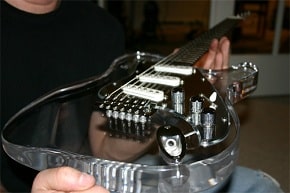
Piezo Electric pickups employ a crystal that has the unusual ability to transform mechanical energy into electrical voltage. During the Sixties, pickup manufactures realized that if a small piezo-electric crystal could be attached to the soundboard of a guitar, the vibrations from the guitar would produce pressure upon the crystal and create a series of corresponding electric pulses. Add a couple of wires and an amplifer, they figured, and—in theory, at least—you should hear something pretty close to the instrument’s true tone. The first piezo pickup format was the contact transducer, a small encapsulated device that could be temporarily attached to the soundboard. The most successful original version was produced by DeArmond, but in the late Sixties Barcus-Berry introduced an improved design that fit inside the guitar, under the bridge. These soundboard transducers are still made today by a number of companies and offer a simple, no-modification solution to amplifying acoustics. However, they replicate only the vibrations of the soundboard, not of the strings. In 1968, Today, many guitar manufacturers offer their own piezo-equipped acoustic or solidbody guitars, and many retro-fit pickups are available as well. If there’s a downside to piezo it’s that they add nasal overtones to the amplified signal. Thankfully, modern acoustic preamps feature equalization filters specifically designed to dial out these harsh textures. |
| Copyright ©2007 PHP Pro Software LTD Gear-Vault Blog |
HOME • SELL • REGISTER • LOGIN • HELP • FAQ • SITE FEES • ABOUT US • CONTACT US • TERMS & CONDITIONS • PRIVACY POLICY | ADVERTISING | DEALERS | LINKS | RATE THE-GEAR-VAULT | GEAR-VAULT BLOG | GEAR-VAULT FORUM |