Auction Your GUITAR and MUSIC GEAR for FREE!
Powered by MaxBlogPress  
Top

Ovation B768 Elite

November 29, 2008 by NAMM · 1 Comment 

Ovation B768 Elite

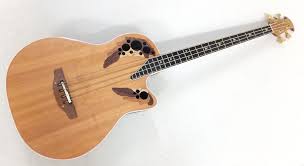
Although the Ovation B768 Elite is designed primarily as a fretted acoustic/electric bass guitars, it’s a great alternative for players who something that approaches an upright bass’s sound without presenting the inconveniences of a fretless neck and unwieldy size. As it sounds great unplugged as well as amplified, it’s also ideal for low-volume gigs that don’t require an amplification system.

Many acoustic bass guitars sound somewhat lifeless and don’t put out too much volume due to their relatively small body sizes. Somehow, Ovation has overcome this problem; the Elite have a body that is only slightly larger than a standard acoustic guitar’s yet it produces loud and lively, resonant sound. This may be partly attributable to the Adamas-style epaulet sound holes, which are of various sizes and spaced across the instrument’s upper bouts. This design retains as much of the solid sitka spruce top’s material as possible, and keeps a solid section of wood underneath the strings to ensure optimum top vibration.

But the Elite also produces outstanding acoustic-electric tones thanks to its built-in OP-X preamp system and piezo pickups mounted to individual string saddles. The preamp is fully loaded, including a gain control with bypass switch, notch control with bypass switch, and EQ cut/boost sliders (Low, 600Hz, 6kHz and High). The gain and notch knobs pop up for easy adjustment and snap down into a recessed cavity where they won’t dig into your chest or get knocked around. The preamp is powered by a single 9-volt battery that is housed in an easy access battery compartment next to the preamp’s controls.

The Bass’s 5-piece laminated maple and mahogany neck is exceptionally stable, and features a manageable 34-inch scale, although its 24-fret neck, single cutaway and center-mounted rosewood bridge make it seem much longer. The rosewood fingerboard is so dark and tightly grained that it seems more like an expensive slap of ebony. Although the fretted neck prevents the instrument from providing true upright tones, players will appreciate the feel and intonation of the Elite’s fretwork.

Advertisement————————————

————————————————————

The End Line

The Elite is a great option for upright players who want to play bass without plugging in. It’s also a great transitional instrument for bass guitarists who want to explore acoustic textures without the hassle of learning the techniques required to play an upright.

Buy – Sell – Trade at USED MUSIC GEAR at GEAR-VAULT CLASSIFIEDS


Subscribe to Gear-Vault eNews!

Voodoo Lab Pedal Power 2 Plus

November 27, 2008 by NAMM · 1 Comment 

Voodoo Lab Pedal Power 2 PlusThe Voodoo Lab Pedal Power 2 provides 9-volt power for up to eight guitar pedal effects. The unit’s eight DC power cables are compatible with most commonly used pedals, and the Pedal Power also features an auxiliary AC outlet for convenient facilitiation of AC-powered effects or MIDI foot controller. Each output is completely isolated, short circuit protected, highly filtered and regulated.

Isolation is more than fixing ground loops.
Ground loops cause hum, and the solution is to break the unwanted ground path. Isolation is the best way to do it. Unlike other power supplies, Pedal Power 2 Plus isolates EVERY output. This eliminates tone robbing interaction between units. Now you can properly power everything from vintage overdrives to modern digital marvels that others just can’t!

Proprietary balanced transformer makes it possible.
A typical transformer, like those used in a wall wart, creates a large magnetic field that causes hum in any audio path near it. Pedal Power 2 Plus uses a custom designed, ultra-low noise toroidal transformer, with separate balanced windings for every output. Now even the most sensitive pedals can be dead quiet.


Switching power supplies aren’t for everything.

What’s good for charging a cell phone is NOT good for your pedals. While digital switching power supplies are small and inexpensive, they also generate unpredictable transients and extraneous noise. Pedal Power 2 Plus uses an audiophile quality linear supply for consistently stable, clean, pure power.
Pedal Power 2 Plus Features

9/12V (x4) – Standard 9V and 12V Boss ACA
With each one of these four outputs delivering 100mA, you can easily power any 9V battery-operated pedals. Boss pedals that specify the PSA adapter operate at 9V like most other pedals. Boss pedals that require the ACA adapter operate at 12V which can be selected via switches underneath the Pedal Power 2 Plus. Any one of these outputs can be individually selected to run at 9V or 12V.

Advertisement————————————

————————————————————


9V (x2) – High Current 9V and Line 6 Modelers

These two outputs each deliver 250mA allowing you run high current draw effects like the Boss DD-20 Giga Delay or Line 6 DL4 Delay Modeler. Via switches underneath the Pedal Power 2 Plus, these two outputs can be separately configured for regulated (Boss Twin Pedals) or unregulated (Line 6 Modelers) power allowing you to run both units if so desired. These outputs can also power any standard 9V effects as well.

9V (x2) – Standard 9V With Battery Sag Control
These outputs each have an available 100mA of power, but also allow you to SAG the voltage from roughly 4V to 9V. This feature can be enabled via the bottom panel switches. The SAG control is mostly useful for transistor-based fuzz, octavia, and distortion circuits, as most modern opamp designs are minimally affected by variations in supply voltage. We recommend turning SAG off if you’re going to run digital pedals like delay, chorus, and reverb.

18V/24V – Using Custom Cables
All of the outputs on the Pedal Power 2 Plus (and the original Pedal Power) are completely isolated allowing you to create different voltages. You can run effects like the current MXR Flanger by combining two 9V outputs to create a single 18V supply. By switching two outputs into 12V ACA mode, you can join them together to create a 24V output for powering numerous Electro-Harmonix stompboxes including the Deluxe Memory Man. For more information, visit Voodoo Lab’s official website.

Buy – Sell – Trade at USED MUSIC GEAR at GEAR-VAULT CLASSIFIEDS


Subscribe to Gear-Vault eNews!

Tube Microphones Review

November 27, 2008 by NAMM · 3 Comments 

Mic Guitar AmpJust as tube guitar amps provide warmer sound and more natural tone than solid state amps, tube microphones accomplish the same thing fir vocals and miked instruments. Classic mics like the Neumann U67 have been a favorite of studio engineers for decades, but today there are several more affordable tube mics on the market that get the job done quite well.

We tested tube microphones made by Audio-Technica, AKG and Alesis by tracking vocals, a Martin D-1 acoustic guitar and a Les Paul through a Peavey Classic 30 combo amp to an Alesis ADAT and direct to a Panasonic 3700 DAT machine. All three microphones were quite impressive, though some seemed better-suited for certain applications than others.

First, a bit of background information. All the mics tested are condensers, which generally offer superior high-frequency response and better sound than dynamic mics. They’re also expensive, sensitive and less durable, so they tend to stay in the studio. In addition, condensers require a power source, and while many of them run on 48-volt phantom power supplied by a mixer through a regular mic cable, tube microphones require their own power supply. Each of the mics we tested comes with an external power supply, a cable to connect the mic to the supply and a noise reducing shock mount.

Audio-Technica AT4060

The Audo-Technica AT4060 ($1249.99) features a unidirectional cardioid pattern that allows it to accept sound from the front and reject it from the back and sides. The mic was great for vocals, providing a full midrange that was neither thin nor muddy and which cut right through the mix. It also performed quite well on acoustic guitar, capturing the instrument’s full, low-end body as well as its higher frequencies, and it was superb for clean electric guitar sounds and solos, picking up the brighter frequencies and delivering a clear, ringing tone.

The AT4060 comes with a small case for the microphone but nothing to hold the power supply and cables required for it—perhaps the company’s way of encouraging you to leave the mic in the studio. Overall, this is a wonderfully versatile mic with excellent low-midrange characteristics.

AKG Solidtube

The AKG Soldtube ($1099) is a large cylinder mic that, like the AT4060, has a cardioid pattern. In addition, the Soldtube has a -20 dB pad to reduce its output and a bass rolloff switch on the power supply. The mic, power supply and accessories come n a handy metal carry case.

The AKG produced a slightly brighter sound than the Audo-Technica, and as a result, vocals had a bit more presence to them, with a high-mid boost that was wonderful. The acoustic guitar sounded bright and punchy, but the AKG didn’t reproduce as much of the guitar’s low end, resulting in a slightly thinner tone. The AKG really excelled on electric guitar, where clean tones rang full and bright and crunchy rhythm tracks were in-your-face huge. This is a reliable mic for “featured track” applications, like lead guitar and vocals.

Advertisement————————————

————————————————————

GT Electronics AM62

Is it any wonder that Alesis, who brought us affordable ADAT recording and inexpensive signal processors, have developed and affordable tube mic that sounds great and is loaded with features?

Manufactured by the company’s GT Electronics Division, the AM62 features a -10dB pad, bass rolloff switch and Groove Tube GT5840M tube. In addition to its cardioid pattern, the microphone can operate in a tighter super-cardioid pattern as well as figure-eight and omnidirectional patterns. The AM62 also comes with a hard mount (although neither the hard mount or shock mount were as steady as the others we tested) and a strong metal carry case.

The AM62’s solid midrange sounded terrific on vocals. While it made the acoustic sound rather boxy, with perhaps too much midrange, the AM62 did a nice job of capturing the instrument’s full tone. The mic worked especially well with the electric guitar, delivering smooth clean tones and a bright distorted tone that helped lead lines cut through the mix. With a variety of features, quality sound and an informative manual (complete with tips on miking different instruments), the AM62 is a workhorse around which you can base your studio.

The End Line

As a multipurpose microphone for vocals, acoustic and clean electric guitar, the Audio-Technica AT4060 delivers the goods. While not as sensitive at revealing the tonal nuances of the acoustic guitar, the AKG Solidtube did a superb job with vocals and with both clean and distorted guitar tone. And for all-around performance and features, you can’t go wrong with the budget friendly GT Electronics AM62. Lean more about Recording Gear

Buy – Sell – Trade at USED MUSIC GEAR at GEAR-VAULT CLASSIFIEDS


Subscribe to Gear-Vault eNews!

Line 6 POD Review

November 26, 2008 by NAMM · Leave a Comment 

Line 6 PODThe law of the rock and roll jungle has dictated that, while electric guitarists get the glory of the girls, bassists have had the small consolation of being able to walk into a recording studio, plug into any half-decent direct box and immediately produce a useable tone. The advent of the Line 6 POD, a stellar and affordable direct-recording device for guitarists, is going to change all that. Now guitarists truly have it all.

Shaped like a space-age kidney bean, the Pod uses Line 6’s trademark digital TubeTone software to create “amp models” that recreate the sound and feel of a wide variety of classic amps (that, of course, includes “modern” classics). For example, the tweed ’53 Fender Deluxe used for the Pod’s Small Tweed setting was extensively tested, so that every aspect—from the overdrive characteristics of the power stage to the interactivity of the tone controls—could be replicated. Other presets in the Pod’s vast sound spectrum include Tweed Blues (’59 Fender Bassman), Modern Class A (Matchless Chieftain), Brit Classic (’65 Marshall JTM45) and Fuzzbox, a satanically accurate recreation of a 1960 Dallas Arbiter Fuzz Face. On presets like Black Panel, where the amp being modeled (a ’65 “blackface” Fender Deluxe) has built-in reverb, the Pod’s reverb control emulates a spring reverb with relative accuracy. For amps that originally came without spring reverb, the control adds a deep, large room reverb.

In addition, the Pod features a full complement of onboard effects as well as built-in chromatic tuner and an extremely effective automated noise gate. When the unit is used to its full capacity as a stereo unit, the Pod’s flanger presets (modeled after a classic Seventies ADA unit) whoosh like a squadron of drunken jet fighters, the chorus is lush and deep, the tremolo pulsates enough for even the most committed radiohead, and the rotary speaker emulator (which, like a real Leslie, operates at slow and fast speeds) is eerily realistic. In addition to the aforementioned goodies, this jam-packed unit also boasts a compressor and a full house of digital delays.

Even with this wealth of features, the Pod’s intuitive, user-friendly interface is completely idiot (read “guitarist”) proof and will feel instantly comfortable to even the most technophobic player. All controls are easily accessible on the front of the unit, and there’s no scrolling or wading through multi-layered data banks.

While the Pod can have its speaker-simulation circuitry bypassed and function as a full-service preamp, we tested the unit in just two environments where the amp emulation circuitry was engaged: first with a set of AKG headphones plugged into the unit’s headphone jack, and secondly with stereo outputs running through a pair of Neve preamps and into a pair of industry standard Yamaha NS-10M studio monitors. Our conclusion: even if you use the Pod solely for private headphone practice, you’ll get more than your money’s worth from this modestly priced unit. Unlike so many other amp emulators, the Pod had bass in spades, and the built-in effects smoothed out the harshness that can result in ear fatigue. Run through the studio set-up, the Pod created a wealth of credible sounds in a fraction of the time that it would take to mic up three amps. I found that even if some of the amp models were slightly off base, each yielded a usable and unique tone. From stinging blues to full-on scooped metal, it was all in there.

Advertisement————————————

————————————————————

Unfortunately, there isn’t room here to discuss the Pod’s full MIDI implementation, which allows sequencers to trigger real-time presets and eq changes, or its PC- or Mac-compatible companion software that gives you additional amp models, cabinet emulations, more effects and editing capabilities. Suffice to say, the Pod has everything and more you could want in a unit of this kind.

The End Line

The Pod’s emulations come very close to the tones of the original amps, and the unit is so reliable and controllable that it will doubtless become ubiquitous in home studios and massive $2,000-a-day recording complexes as well. This is a no-brainer, slam-dunk, must-have tool for any guitarist serious about tone.

Buy – Sell – Trade at USED MUSIC GEAR at GEAR-VAULT CLASSIFIEDS

or

Musician’s Friend: New Products


Subscribe to Gear-Vault eNews!

Z. Vex Seek Wah Guitar Effects Pedal

November 24, 2008 by NAMM · Leave a Comment 

ZVex Seek WahSo there you are, sitting in from of your digital recorder, trying to work out an overdub. Problem is, you keep going back to the same stock phrases. The same thing happens at practice when, while running through your band’s newest song, you suddenly realize you’re falling back on all your old, familiar tricks.

We all fall into creative ruts once in a while, and while opinions on the cause may vary, everyone seems to agree that nothing breaks you out of a funk like a cool new toy. And while that ’68 Strat in the store window could certainly get you excited again, the right effect could actually improve or expand your playing style, and it wouldn’t cost you nearly as much.

Enter the ZVex Seek Wah. The brainchild of a lunatic genius named Zachary Vex and manufactured in Minneapolis by his company, Z. Vex, the Seek Wah ($300 – $350) is part tremolo, part wah-wah, part analog sequencer and part something entirely new. To get an idea of what it does, think of what a wah-wah pedal sound like when you’re not rocking it back and forth. If the pedal is left in a high position, the sound is shrill and pinched, while in a low position, it’s muffled. Now imagine eight wah-wah pedals laid out in a circle, with your signal passing from one to the next, looping around and around. That, in short, is the sound of the Seek Wah.

Packed into a two-by-four-inch housing, the Seek Wah has eight tiny knobs with which you dial in a setting for each of the eight wah filters. A tempo knob lets you set the rate at which the signal loops through the filter, and a three-way toggle switch lets you choose whether the signal loops through a sequence of four, six or eight filters.

Thanks to this high level of control, you can instantly create mind-bendingly complex and shimmering vibratos, slow echo-like pulses or all varieties of time tremolo. The looping creates a rhythm of tonal peaks and valleys, something that makes the Seek Wah particularly useful and inspiring for songwriters. Allowing the Seek Wah to set the rhythm can create polyrhythms you might not have thought of on your own, let alone been able to execute.

One of the Seek Wah’s unique quirks is that all the rotary knobs work counter-intuitively: turning to the right “closes” the filter up, deadening the sound, and turning to the left “opens” it, giving you that classic wah bite. A row of flashing LEDs under the filter knobs gives a visual picture of the sequence, and the relative brightness of each one is a reflection of that particular filter setting.

Advertisement————————————

————————————————————

We found the Seek Wah was best suited to simple playing and sustained chords; fast picking and strumming tend to get lost, especially when the unit’s tempo is set high. Although the “backward” controls took some getting used to, it was easy to design a specific rhythm with the unit, as if it were a drum machine. By setting the Seek Wah for a sequence of four wah filters, we created a standard backbeat by setting the first and third wah controls at three o’clock and the second and fourth at eight o’clock. This was apparently what Z. Vex had in mind when they provided the Seek Wah with the three-way sequence switch. The six-filter setting works well with songs that are in ¾ or 6/8, and the eight-filter setting is good for all variations of 4/4.

The Seek Wah runs on a single 9-volt battery and, like all Z. Vex effects, is entirely hand-made and works as a true bypass when not activated. The unit comes in a colorfully hand-painted housing, adding one more level of individuality to this most-unique effect.

The End Line

In a perfect world, the Seek Wah’s already numerous knobs would have as additional companions controllers for effect blend and output level. These would make it more flexible in live situations. But near-perfect is entirely close enough, and even with its steep price tag, the Seek Wah is a must-have.

http://www.stevesmusiccenter.com/zvexseekwah.html

Buy – Sell – Trade at USED MUSIC GEAR at GEAR-VAULT CLASSIFIEDS

or

Musician’s Friend: New Products


Subscribe to Gear-Vault eNews!

Egnater Tourmaster 4100 and 4×12 Cab

November 22, 2008 by NAMM · 1 Comment 

Egnater Tourmaster 4100 and 4x12 CabFor three decades Bruce Egnater has been building and designing amplifiers which have inspired many modern amplifier builders with their balance and serious high-gain tones, and to this day remains a major point of reference for boutique amp builders looking for that killer distortion. Of Egnater’s talents, his design of multi-channel amps is prominent, which is solidified with his contribution to the design of Rocktron’s TOL amplifier series as well as the Modular Tube System (MTS) amps from Randall.

One of Egnater’s more notable amps, the Tourmaster, is a work of art that is packed with a variety of sounds, gain levels, and features – all packed in a 75-pound monster. The Tourmaster features four preamp channels, voicing options and a contour circuit to give you a wide range of tones, suitable for just about any player. However, Egnater also includes their Power Grid control, which allows you to adjust the wattage of the amplifier, which takes versatility to a whole new level. The Tourmaster gives you the ability to switch between 10, 20, 25, 50, or 100 watts of power on any of the four channels. To top it off, the Tourmaster is a tube-driven amp, using four 5881s and a whopping eight 12AX7 tubes (all from Groove Tubes).

Egnater’s Features

The Tourmaster’s assortment of cool features are not just numerous, you can actually use them, as well! The Tourmaster features both low and high gain inputs as well as four different preamp channels (Clean/Vintage 1 and 2, Overdrive 1 and 2). Each individual channel also features identical sets of volume, treble, middle, bass, and gain controls in addition to a voicing switch (for setting the channel to classic or modern voicing). The switchable voicing tool (the ‘contour’ circuit) allows you to change the midrange curve from wide and scooped to a more focused, forward tone. The amp also has a global volume control, reverb, density and presence controls. Also, the Tourmaster comes with a six-button footswitch, allowing you to remotely control all four channels, the effects loop, and reverb.

The amp’s back panel is also packed full of features, such as a speaker-simulated recording output (with dedicated level control), tube-biasing test point, dual speaker outs (with settings for 4-, 8-, and 16-ohms), and tube-driven series/parallel effects loop (which is channel-assignable and switchable) with send/return level controls.

Using the Power Grid on the rear panel of the Tourmaster, you can assign different power options to each channel (thanks to a custom-designed transformer) using slider switches from 100, 50, or 20 watts (with a ‘half-power’ switch to cut them to 50, 25, and 10 watts respectively).

Advertisement————————————

————————————————————

Egnater’s Performance

The Tourmaster was tested through a Tourmaster 4×12 cabinet loaded with Celestion Vintage 30 speakers. One great feature about the cabinet is that the jack will detect impedance automatically, taking the guesswork out of connecting safely to a variety of amps.

It is very easy to make great tones with the Tourmaster, thanks to Egnater’s custom compression, which is able to focus the amp’s tone at high volumes without limiting the dynamics as it enhances the strength of the tone. The amp’s voicing is open and airy when set to classic, and the modern setting increases the amps punch and response. The Tourmaster’s Clean/Vintage 1 channel has no trouble replicating the spongy, dark tones of the Blackface era and can even match a late-sixties Deluxe when set to a lower power setting. On the Clean/Vintage 2 setting, the amp delivers more gain and bright tones, which are great for more bluesy solos and dirtying up clean rhythm sounds.

Egnater’s Overdrive 1 channel presents a round, more granulated, and detailed distortion, unlike most British overdrive channels, which tend to be more sharp and jagged, and it generates plenty of distortion for those classic rock and metal sounds. Overdrive 2 brings out the big guns, using every bit of the Tourmaster’s ability to generate gain while still giving every note the all-important punch. The amp’s reverb is also not overwhelming of the overdriven tones.

Bottom Line

The Tourmaster 4100 is yet another star in the multi-faceted and versatile lineup of Bruce Egnater’s amplifiers. You will love the five Power Grid options for each individual channel, as well as the Tourmaster’s unique way of controlling response. To top it all off, the Egnater Tourmaster will deliver regardless of which style of music you throw at it at about half of the price of similar amplifiers.  Musician’s Friend: New Products

http://www.egnater.com/

Buy – Sell – Trade at USED MUSIC GEAR at GEAR-VAULT CLASSIFIEDS


Subscribe to Gear-Vault eNews!

Uni-Vibe Inspired Effects Pedals

November 21, 2008 by NAMM · Leave a Comment 

Vintage UniVibe effects pedalMultiple personality disorder may be a debilitating condition in humans, but it’s a delightful quirk in effects pedals. With small digital multi-effects pedal so prevalent these days, it’s always refreshing to check out a few analog stomp boxes that feature some pleasantly psychotic twists.

To that end, we subjected three effects pedals to analysis: three distortion related units—inspired by the venerable Uni-Vibe—Jim Dunlop’s Uni-Vibe Stereo Chorus, Fulton’s Deja Vibe and Roger Mayer’s Voodoo Vibe. While no two pedals were exactly alike in function, each possesses a dual nature that, when fully exploited revealed unique opportunities for extreme sonic manipulation. Any guitarist bored by conventional sounds will find plenty to get excited about in these boxes.

All three pedals were tested with fresh 9-volt alkaline batteries, and their signals were sent to a variety of amps including a Marshall JCM800, a Fender Pro and a cute little solid state Fender Bronco. We also fed Uni-Vibe—inspired units into a multi-channel mixer to better examine their stereo output.

JIM DUNLOP UNI-VIBE STERO CHORUS

Back in the day, organists who couldn’t afford a bureau-sized Leslie speaker cabinet would beef up the tone of their Farfisa and Vox combo organs with a little unit called the Uni-Vibe. Manufactured by the Univox Company, the Uni-Vibe did a fair job of replicating the Doppler effect of a Leslie cabinet’s rotating horn. And unlike a Leslie, it weighed far less than a small refrigerator. It was Hendrix, again, who dug the Uni-Vibe as a guitar effect, claiming it for future six-stringers like Eric Johnson and Stevie Ray Vaughan.

The Jim Dunlop Company, which owns the Uni-Vibe name, has been manufacturing several famous variations on the pedal for years. The Uni-Vibe Stereo Chorus can be thought as “one Uni-Vibe to go, hold the bells and whistles.” Unlike the Univox original, which consists of an AC-powered, book-sized enclosure connected to a speed-varying pedal, the Dunlop unit is of classic stomp-box proportions and runs on either a 9-volt batter or an adapter. Dunlop has also modified the circuit to vary continuously from “vibrato” to “chorus” (the original was an either-or proposition), and they’ve thrown in some clever stereo circuitry to boot.

The resulting sound is a solid simulation of the original. The chorus is whirly and whooshy, with plenty of air and phasing, while the vibrato imparts a mild pitch shift that undulates evenly throughout the entire range. There are no rude hiccups at the fast speeds, and the slow settings won’t give you that “who put the Quaaludes in my beer?” feeling. In addition to speed and intensity controls, the Uni-Vibe features a pilot light that faintly pulses in time to the speed settings.

The real fun comes when you work the mix control in association with the stereo output jacks. The mix ranges from “wide” to “mono,” and the outputs are labeled “left/chorus” and “right/vibrato”. With the mix set wide, the left output is dry and the right output is full, pitch-warbling vibrato. Pan the mix to mono and the left output comes alive with chorus, while the right channel’s vibrato gradually morphs into matching chorus. These various permutations give you the opportunity to use the Uni-Vibe with either the right output alone, varying the mix between vibrato and chorus, or with both outputs for a stereo spread that can range from vibrato-plus-dry to vibrato-plus-chorus (which sounded lovely in headphones) to dual-mono chorus.

With the Uni-Vibe in bypass mode, I was able to detect some signal coloration, a not unpleasant high-end sheen most evident in the pick attack. This minor complaint aside, the Uni-Vibe will please guitarists who want to add rotating speaker tone to their arsenal without breaking their back or spending an arm and a leg.

FULLTONE DEJA VIBE

If you are even remotely aware of Mike Fuller’s Fulltone pedals, you won’t be surprised to know that he’s nailed the vibe of the original Uni-Vibe. Fullton currently offers the Deja 1 (mono or stereo), which comes with a large knob for controlling the rate of speed, and the Deja 2 (mono or stereo), which features the more traditional pedal speed control. Although we set out to test a mono Deja Vibe 2, we were lucky enough to score a stereo Deja Vibe 1 in time to check out its dual-output capabilities. The controls on both units are simple and almost identical to the original Univox model: chorus/vibrato selector switch, intensity knob, on-off footswitch, speed pedal or knob and—perhaps the only concession to modern values—a “modern/dark” switch.

Advertisement————————————

————————————————————

Fullton pedals are known for both their stunning sound and rugged construction, and the Deja Vibe is no exception. The chorus and vibrato settings are warm and full, and the speed pedal gives you the ability to mimic the slow-to-fast rotary sound of a Leslie cabinet. Unlike the original pedal, the Deja Vibe has full bypass, so there’s no need to stick this in an effects loop to isolate it. About that modern/dark switch: the original Uni-Vibe was designed for the slightly higher and brighter outputs of compact organs, and the sound is somewhat dark when driven by a guitar. Flick the Deja Vibe from to dark to modern and you’ll get a nice little boost along with a less “loaded-down” tone. Furthermore, the stereo models feature true stereo output, creating a back-and-forth undulation in the sound field that none of the other Vibe pedals possessed.

The vibrato setting was especially nice with a slightly overdriven amp. Normally this is a recipe for disaster, since modulated pitch-shifting devices can get pretty ugly when distorted, but the Deja Vibe sounded like it was made for this purpose, achieving the wicked grind of Eric Clapton’s solo on “While My Guitar Gently Weeps.” That vibrato, by the way, has the loveliest bottom-end “thump.” I understand that connoisseurs of the original Uni-Vibe listen for just that thump when evaluating other units.

ROGER MAYER VOODOO VIBE

Roger Mayer didn’t invent the Uni-Vibe, but you can bet he spent plenty of time nipping and tucking at the guts of the models Hendrix owned. After Uni-Vibe production ceased, Mayer produced his Supervibe, used by both Stevie Ray Vaughan and Robin Trower. The Voodoo Vibe is the latest generation of this evolutionary chain, offering an immense amount of flexibility while remaining true to the Uni-Vibe tone.

The Voodoo Vibe is housed in a book-sized, cast-metal box with seven black pointer knobs. The function knob offers a choice of chorus, vibrato and (surprise!) tremolo. The speed of each effect can be set with the range knob, which chooses either a sine or triangle wave in slow medium or fast mode, and tuned in precisely with the fine knob. The intensity and output knobs vary the depth of the chosen effect and the final output of the signal, respectively, and the symmetry and bias controls actually shape the wave you’ve chosen, creating giddy roller-coaster sensations in the shower vibrato settings and helicopter-like “woof” sounds at faster speeds.

For those who desire the pedal option of the original Uni-Vibe, the Voodoo Vibes lets you control its speed by plugging any standard volume pedal into a couple of jacks on the back. The dual-output jacks are low impedance and deliberately active (though totally uncolored) for parallel processing and driving longer cable lengths. The power source can be either a 9-volt battery or an adaptor, and the Voodoo Vibe has a status LED.

The sound of the Voodoo is simply stunning. It was possible to teak it just so and imitate the original Uni-Vibe sound, but this unit is inspired by the Uni-Vibe, not just a clone or an upgrade of it. The vibrato effects call forth the aforementioned roller-coaster and helicopter sensations, as well as bubbly underwater effects, with ease. The chorus is so lush and full, it simply bears no comparison to the average pedal. And if you’ve been hoping to come across a vintage amp with a working tremolo circuit, save your time: the Voodoo Vibe can cop the shimmer of those old Fender, Vox and Ampeg tremolos, and go into some pretty extreme volume-chopping effects as well.

End Line – If the original Uni-Vibe sound is your Holy Grail, the Deja Vibe is your pedal. For a deep sound-shaping tool, check out Voodoo Vibe, a multifunctional monster that will put half a dozen little colored boxes out to pasture.

Buy – Sell – Trade at USED MUSIC GEAR at GEAR-VAULT CLASSIFIEDS


Subscribe to Gear-Vault eNews!

Visual Sound Jekyll & Hyde Ultimate Overdrive

November 20, 2008 by NAMM · 1 Comment 

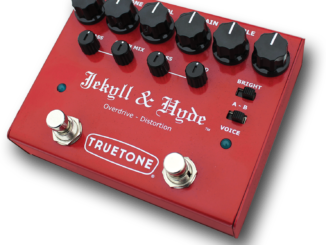
Visual Sound Jekyll & HydeLiterature’s most famous split personality takes musical form in this two for one pedal. Many players use two distortion pedals—one for a mild, tube overdrive and another for a fuzzier sustain. Stomp them together and you get sonic meltdown. The trouble is the slightest tweak can result in annoying microphonic feedback or impotent mosquito buzz.

Bless the good Dr. Jekyll and his more aggressive alter ego, Mr. Hyde, for getting these two distinctive sounds to work together so well. The Jekyll & Hyde Overdrive is a maximum bang per buck bargain. Enclosed in a sheet metal casing worthy of a Sherman tank, this Siamese twin of sound boasts two selectors’ switches two status lights and a row of knobs that beg you to bend over and tweak em.

Jekyll the milder mannered channel can be shaped with drive, tone and volume controls. The voicing is very much of the Ibanez Tube Screamer/ProCo Rat School of overdrive, delivering a steroidal version of your basic signal with lots of dynamic headroom. The high midrange is gritty yet well balanced and a nice tube like honk appears in the low end when you roll back your tone control. Hyde, the aggressive half of the team, is brought out with drive, tone, eq, and volume controls as well as a sharp/blunt switch. Compared to Jekyll, Hyde has a little higher end edge coupled with a tight and sweet bottom that gives most settings the added thunk of 4×12 cabinets. The eq control mixes the ratio of lows to mids and in the extreme clockwise setting it nails the scooped mid sound once beloved of Metallica.

Advertisement————————————

————————————————————

While the effects can be used independent of each other, the real fun begins when they are both on. Push the brighter aspects of each channel and you’ll arrive at a tone that could shame the sun, with squealing pick attack and effortless harmonics. The darker side will create the illusion of a wall of Marshall’s, even when using a little 20-watt solid state practice amp. But beware: like any true psycho the Jekyll and Hyde can push too far. Max out both drive knobs and the resulting feedback won’t be pretty.

The End Line
The Dr. Jekyll & Mr. Hyde is a serious gigging tool for lovers of overheated overdrive, one that is easy to use and sounds great.

Buy – Sell – Trade at USED MUSIC GEAR at GEAR-VAULT CLASSIFIEDS


Subscribe to Gear-Vault eNews!

Tech 21 CompTortion Guitar Effects Pedal Review

November 20, 2008 by NAMM · Leave a Comment 

Tech 21 CompTortion

Distortion and compression are twin faces of the same personality. Compression can give a guitar the violin like sustain many players seeks in a good distortion pedal, while distortion can iron out transients in a way similar to a compressor. The marriage of both effects in one pedal would seem a foregone conclusion, but a noise gate would be required to eliminate the resulting noise, and the interaction of all three items adds up to a rather dysfunctional family.

You can thank Tech 21 for organizing everything into one stomp box sized pedal without sacrificing a drop of professional sound quality. The CompTortion features controls for level, tone, compression, and distortion. Each effect can be dialed up independently or mixed together in whatever ratio you need. The noise gate is hardwired into the circuit and requires no controls. As an added testament to the lack of coloration in the CompTortion’s signal chain, both the compression and distortion can be dialed down, leaving a clean signal which can be boosted 12db via the level control.

Advertisement————————————

————————————————————

The pedal’s compression circuit is powerful, providing a range from 1:1 to a totally squashed 15:1. Lovers of country rock and power pop will embrace the clean compression settings. If you crave the long, vocal sustain of Robert Fripp or Tom Sholz, simply back off the compression and add more overdrive. Lose the compression altogether and dial up the tortion to find out why Kurt Cobain was so fond of the Tech 21 pedals.

The End Line – For those who crave effects of a more schizoid mature, the CompTortion is the Swiss Army knife of pedals, with noise suppression circuitry and an analog signal path… Just fantastico!

Buy – Sell – Trade at USED MUSIC GEAR at GEAR-VAULT CLASSIFIEDS


Subscribe to Gear-Vault eNews!

Jackson Demmelition King V Electric Guitar

November 19, 2008 by NAMM · Leave a Comment 

Jackson Demmelition King V Electric GuitarPhil Demmel of Machine Head recently teamed with Jackson Guitars and integrated an element of masochism to conceive a dangerous new breed. Demmel’s legendary riffs smash us over the head like an annihilated sledgehammer, slaying our eardrums for a diabolic revelation, knocking out our teeth from an infuriated mosh pit…allowing us to stumble home with a grin plastered on our toothless bloodied face. Would it be sweet if you could abuse your audience like that? Guess what, you can.

Look at the company for bringing us all this brutal carnage; Jackson Guitars with the new Jackson Demmelition King V. There’s nothing timid or reserved about the Demmelition’s bombastic, bowel loosening assault, yet it’s very tonally balanced instrument. Part of Demmel’s sound requires a special guitar characteristic to help create his super-vintage yet modern-vintage assault.

“You don’t mess around with the Demmel-ition man,” retorts Jackson on the official website, which is a fair statement, with the Demmelition using dangerous-pointed metal-sadistic jagged cutouts. The standard King V shape guitar is more than an axe, it’s a weapon.

The Demmelition comes from the factory loaded with massive .011 – .056 GHS Boomers drop-tuned to B. For added stability and sustain, the Demmelition is constructed with neck-through-body, the maple neck is quarter-sawn to protect against warping and twisting featuring a bound compound-radius ebony fretboard. The compound radius begins a 12-inches and flattens gradually to a hammer-friendly 16-inches above the 12th fret. The Demmelition sports 24 jumbo frets, mother-of-pearl shark fin position inlays and black-bound headstock with an inlaid mother-of-pearl Jackson logo.

Advertisement————————————

————————————————————

A classic set of active-metal-style pickups–EMG-81 (bridge) and a EMG-60 (neck)–delivers relentless power, detuned clarity and precision punch. Although you would normally see the EMG-81 paired with an 85 in the neck position, the ceramic-based model 60 is an excellent choice if you yearn for destructive rhythm tones and wailing neck leads from the heavy gauge strings. Each pickup is hardwired directly to its own volume pot (the Demmel does not employ any tone knobs), and a three-way blade lets you select each pickups or blend the combination together. An Original Floyd Rose (OFR) double locking tremolo divulges a classic metallic resonance upon the mischievous King V.

The Jackson Demmelition King V is a wicked-winged flyer that is purposely built for high gain, intense chunky lows and greasy-thick leads. All the while, the instruments maple neck-through construction, ebony fret board and ceramic active EMGs deliver enough treble enhancement to define the Demmelition’s underlining powerful detuned thick-bass tones make this guitar screaming with a vengeance high-end tones part of the axes personality.

Through a high-gain amplifier, like a Mesa Boogie Dual Recto, the Demmelition sent a holocaust of sound across the stage that enticed a Tyrannosaurus-Rex-like-roar overtones when I chugged on some power chords or drive-bombed the low B string. In addition to its behemoth tone, the Demmelition produced incredible sustain in the higher-note, allowing upper-pitch-bends to be held for well over 20 seconds! The EMGs had no issues delivering clean and warm tones that sound absolutely natural.

The End Line-

If you are a guitarists which desires an extreme machine that is capable of delivering ultimate heavy tones, then look no further, the Jackson Demmelition Phil Demmel signature guitar is your fix. The name says it all: brutal assaults, unrivaled destructive power, bone-crunching lows, relentless sustain and honorable Jackson Soloist style playability.

Buy – Sell – Trade at USED MUSIC GEAR at GEAR-VAULT CLASSIFIEDS

See All Jackson Products at Musiciansfriend.com


Subscribe to Gear-Vault eNews!

Next Page »

Bottom