AXL Guitars Faultline Bass Heads and Cabs
October 30, 2008 by NAMM · Leave a Comment
AXL Guitars, San Francisco-based company, take another leap forward in the quest to create earth-shaking tones, releases their FAULTLINE series of Bass Amplifier heads and cabinets. Read more

T-Rex Twister Chorus/Flanger Pedal
October 29, 2008 by NAMM · Leave a Comment
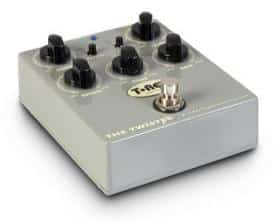
T-Rex introduces the latest member of the stomp box family of effects named, the Twister. The Twister contains both flanger and chorus in one single rugged box, which makes it an outstanding choice for guitarists!
Flanger and Chorus are two all-time classic effects that are so closely related that a single stomp box can produce them both. T-Rex wanted to give you both great effects in a single pedal. While the chorus produces a compelling sparkle and shine to your sound, the flanger puts a funky blend on both single-notes and chords. Hear it for youself, and you’ll discover how it’s the wild and unusual effect you’ve been longing for.
The Twister is packed with features that make sure that you get the chorus or flange blended just the way that you want. What’s more, the Twister has a mono output for running through an amp on stage, and stereo outputs for the studio and live stereo situations. In chorus mode, the light/heavy switch allows you to quickly toggle between two classic variants of the chorused sound, while the tone control allows you take off some of the top for a more subtle effect. And rest assured: like every pedal T-Rex makes, The Twister not only sounds phenomenal, it’s extremely rugged.
————————————————————
T-Rex Twister specifications:
* Input Impedance @ 1KHz: 464KOhm
* Output Impedance@1KHz : 370hm
* Power supply: 9V DC (Power tool 9)
* Minimum Power supply Voltage: 8,5V DC
* Maximum Power supply Voltage: 12,5V DC
* Current Draw @ 9V DC: 81mA
* Maximum input signal Vp/p: Adjustable
* Battery Type: 9V battery 6F22
* Battery Life: 1/2 to 1 Hour
* External connectors: Input Jack. Output Jack (L), Output Jack (R), 9V DC jack
* Controls: On/Off, Level, Depth, Regen, Tone, Rate, Chorus/Flanger, Light/Flanger
* Depth: 120mm
* Width: 100mm
* Height: 55mm
* Weight (excl. battery): 0,430Kg
Visit their official web site at www.t-rex-eng.com.
Buy – Sell – Trade Used Music Gear at Gear-Vault Classifieds

Tascam DP-004 Digital Pocketstudio
October 29, 2008 by NAMM · 2 Comments
TASCAM has revealed a new recording device called the DP-004 Digital Pocketstudio, the DP-004 is a portable four-track digital recorder. TASCAM has more than 30 years of Portastudio ® innovation, the DP-004 maintains their legendary ease-of-use of cassette-based four-track recorders but enhances it with CD-quality digital recording technology.
Instead of confounding menus and windows, the Pocketstudio uses a set of dedicated buttons and knobs for easy operation. A pair of unbalanced 1/4″ inputs accept line or mic signals, or musicians can employ the nifty little built-in stereo microphone. In addition, a stereo mixdown track is also included, and tracks or mixes can be easily transferred to a computer using USB 2.0. Another thing that we find cool about the DP-004, it’s smaller than a paperback book and is portable enough to bring anywhere.
————————————————————
“TASCAM invented the field of home recording with our easy-to-operate Portastudios,” said Paul Jenkins, VP of Sales and Marketing for TASCAM. “The DP-004 is our most portable model yet, just plug in the included AA batteries and take it anywhere. It’s the perfect holiday gift for students, songwriters and musicians”
The DP-004 records to an SD Card, TASCAM also was kind enough to include a 1GB media card with the device. It features autopunch recording, track editing and an undo function. A tuner and metronome are built-in, and the Input “A” jack accepts a guitar-level signal for direct recording. The DP-004 will be available in November 2008 with an estimated street price of $199.
For more information, visit their web site at www.tascam.com.
Buy – Sell – Trade musical equipment at Gear-Vault Classifieds

T.C. Electronic M3000 Studio Reverb Processor
October 28, 2008 by NAMM · Leave a Comment
T.C. Electronics has a reputation for making great-sounding processors. Their gear isn’t necessarily the easiest to use, and it’s certainly not the cheapest. But the products of this Denmark-based manufacturer always exhibit an attention to detail, functionality and overall quality of which few other manufacturers can boast.
The M3000 Studio Reverb Processor fits right in with this aesthetic. The single-space rack unit provides a wealth of effects, including compression, de-essing, chorusing, flanging, tremolo, phasing and pitch shifting. But as the name suggests, the focus here is on the effects that you’ll use the most: the reverbs and delays, both of which the M3000 provides in abundance. The M3000’s room effects, in particular, are warm and natural, possessing wonderful clarity and adding ambiance to a mix without cluttering it up. You don’t hear the reverb as much as get a sense of the sounds existing in an actual space.
With a retail price of $1,799, the M3000 is not aimed at kids with four-track setups. But if you’re willing to shell out big bucks for your studio, you’ll want to invest in a quality piece of equipment.
Since it is a professional piece of gear, the M3000 connects to a mixer through balanced XLR connections; there are no ¼-inch or RCA connectors here. The unit also offers a variety of digital inputs and outputs (ADAT Tos-link, Wordclock RCA, AES/EBU and S/PDIF), as well as MIDI jacks to communicate with other devices.
Getting the unit up and running was simple. Within a few minutes, I was flipping through presets and listening to a variety of deep, rich, clear reverbs and playing with more dramatic effects combinations, like flangers and phasers.
The front panel is divided into sections, with buttons for general setup (routing, MIDI, I/O, levels), controls for each of the two effects processing engines are linked together and some navigation and editing buttons. The screen is easy to read, but given the M3000’s high degree of flexibility, it figures that you’ll have to do a fair amount of scrolling and browsing to get to all of the options.
The unit comes programmed with 300 presets, and it’s hard to imagine anyone not finding some of them to their own personal taste. However, everyone likes to tweak, so the M3000 also has space for 300 user presets. Editing the presets is fairly simple. A touch of the edit button gives you about nine parameters (depending on the preset), which you modify by scrolling through them and turning the dial. There’s also an “expert” mode that gives you a list of adjustments you can make within each preset. Creating your own settings is a little more complicated, especially if you haven’t programmed similar effects processors before. Experienced engineers will be able to get through it with the manual, but novices are better off tweaking the factory presets (or, in most cases, just using them as-is).
————————————————————
The M3000 uses T.C.’s VSS3 (Virtual Space Simulator) technology, with 24-bit analog-to-digital and digital-to-analog converters. All you really need to know about the specs is that there’s no noise and unbelievable clarity. The two engines can function as two independent processors or be combined and routed in a variety of ways.
The possibilities of what the M3000 can do and how it can be configured are wide open. But in my tests, I got the best results by flipping through the presets (particularly the 50 that combine both engines), finding one that suited a particular application and tweaking it as necessary. Reverbs large and small, delays, phasing effects, tremolo sounds…they’re all here. What’s more, the M3000 lets you store combinations of pre sets and routing patterns via its recall/snapshot function, set delay times via tap tempo and change effects automatically based on the level of the signal (a little thing called dynamic morphing).
The End Line
Many processors on the market focus on the number of effects they offer and how many you can use at a time. The reality is that in most live or recording situations, you just want a simple reverb that will bring your mix to life. The M3000 offers tons of them, along with the ability to adjust them fairly easily. What’s more, it features just about every other studio effect you could need, with high-quality sounds and tasteful presets. Whether you’re someone who likes effects and wants to tweak every parameter, or you’re just looking for a processor with a few factory presets you’ll use time and again, the M3000 has what you need.
Buy the T.C. Electronic M3000 Studio Reverb Processor at Musiciansfriend Hot Buys – Recording Gear
Buy – Sell – Trade Used Music Gear at Gear-Vault Classifieds

Rick Gram Studios Tz-1 Woman Tone
October 27, 2008 by NAMM · Leave a Comment
“Nipples glow red when ON!” boasts the brochure for Rick Gram Studio Tz-1 Woman Tone. And indeed they do. Activate this titillating tone bender and you’ll be pleased, amused or maybe just outraged to find that the red LEDs illuminate the bountiful breasts of the bodacious blond silk-screened on the control panel of this creamy overdrive unit.
But if the packaging of the Woman Tone is outrageous, the tones it produces are as classy as they come: warm, responsive overdrives that react with smooth subtlety to variations in picking attack and guitar volume. Like Ibanez’s hallowed Tube Screamer or Boss’ now extinct OD-1 Overdrive pedals, the Tz-1 is not designed to produce gobs of gain. It instead excels at reproducing the creamy, compressed tones obtained by flooring classic non-master volume Marshall and Fender amps.
The plastic casing and input and output jacks may eventually crumble at the feet of booted bruisers, and a tone control would have been a welcome addition to the level and gain knobs. But the Woman Tone’s innards, which include noise quashing internal voltage-regulation circuitry and tone-saving virtual-bypass circuitry, are thoughtfully designed and well assembled.
Rick Gram Studios also offers the Catch-A-Buzz and the Franken Tone fuzz/distortion pedals. They, however, are not mammary powered.
Find – Buy – Sale and Trade used music gear at Gear-Vault Classifieds.
————————————————————

Gibson Goldtone GA-30RVS
October 27, 2008 by NAMM · Leave a Comment
While Gibson is known primarily for making fine guitars, their amplifiers predate any Fender or Marshall amp by at least a decade. The company’s excellent tube amp offerings dried up in the Sixties, but with any luck, the introduction of the 1999 Goldtone series would hopefully be the beginning of putting Gibson amps back on the map.
Developed by Trace Elliot as the Velocette series, and renamed after Gibson bought up the company in 1998, the Goldtone series consist of the bare-bones GA-15, the reverb-adept GA-15RV and the comparatively maxed out GA-30RVS. Each amp was based on a 15-watt Class A circuit powered by EL-84 tubes, and came with nattily attired in soft brown leatherette with gold hardware.
Although it was the series’ flagship, the GA-30RVS offered just a trio of knobs) volume, tone and reverb) to perform most of the work. It’s really deceptively simple, though, because each control covers a wide range of territory. The volume knob can be pulled out for a hearty gain boost, and the tone control engages two potentiometers, allowing the bass setting to have a midrange boost that becomes scooped as the knob is turned toward treble. The resulting range is enormous, and useful at every point. The “pseudo-stereo,” three-spring Accutronics reverb can be controlled by a footswitch (included) and is well voiced and quite strong. Most players will find it useful in small doses, but ambient addicts could thrive on its cloud cover. Other features in the GA-30RVS include a bright switch, a hi input, a lo/link input that allows you to link in parallel to another amp and a stereo effects loop that operates in series or parallel and whose spread can be enhanced with the stereo outputs.
With its volume and tone knobs set for high noon, the Goldtone GA-30RVS kept a moderately clean attitude while putting out a hearty volume level. Engaging the bright switch brought subtle detail to the fore. With the gain circuit engaged and the volume knob leaning toward three o’ clock, the power and girth of the amp became jaw-dropping, while the beauty of the Class A circuit and the EL-84 tubes became very apparent. The highs were always present, yet never overbearing, and the signal remained warm and full, with just a hint of smudginess in the bass. At almost any setting, the mids kept their rich, wooden complexity, which is aided by the dual Celestion Vintage 30 speakers. If we had any gripes, they were with the Goldtone’s controls, which are located on the amps back panel. If you’re a “set-it-and-forget-it” kind of player, then you’ll understand all the praise the Gibson Goldtone series received.
Find – Buy – Sale and Trade used music gear at Gear-Vault Classifieds.

Fine Tune your Tone – Tweaking Edition
Over the past months, I’ve opened countless emails from frustrated players who would like to customize their tone but can’t achieve the ideal sound that they hear in their head. It’s as though the tone they’re seeking exists somewhere beyond the limits of the knobs and switches on their gear. Some of these players ask me if they should change their brand of speakers or cables, or switch to different pickups or try using heavier or lighter gauge strings. In nearly every instance, “cost” is the common concern of these players, since few of them have heaps of money to spend in their pursuit of tone bliss.
Obviously, every player has his or her own guitar setup and rig. For that reason, there isn’t one universal answer that satisfies every question I receive on this subject. However, there is one aspect of tone controls that is at the heart of every guitarist’s quest for a great sound—namely, equalization. No matter what equipment you’re using, equalization can do wonders to help you achieve the guitar sound of your dreams.
Oddly, not many players think about experimenting with equalizers. They really should, because equalizers provide very specific control over the combined frequencies that make up sound. Using an equalizer, you can adjust the individual frequencies of your tone, making alterations that vary from subtle to drastic. The best example of this is a wah-wah pedal, which is actually an equalizer with rotary control that sweeps through a range of frequencies. When you rock the pedal, you change the frequency of the signal in real time.
Equalizers come in two types: graphic and parametric. A graphic eq divides the audio spectrum into a number of “bands” and provides a sliding volume control for each of these bands. Moving a slider up or down from its center position increases or decreases the volume of that frequency.
Parametric eqs use rotary controls to attenuate tone. A parametric eq allows you to sweep a range of frequencies and dial in the center frequency that you want to adjust, then boost cut that frequency with another control.
————————————————————
Anyone who’s experimented with an equalizer knows that it can be a powerful tone-shaping device. Depending on the level of control it provides, an equalizer can transform shrill sounds into warm tones and deliver gain level compensation and signal boosting, which can be extremely useful under the right circumstances.
If you’re interested in getting your feet wet, I highly recommend the Boss GE-7. It’s a well made pedal, and sells for a reasonable price at MusiciansFriend’s Clearance Explosion sales (or find one used for about $50 bones,) it doesn’t cost an arm and a leg. The GE-7 provides a high degree of tone control and can help you get the sounds you’re looking for, regardless of your musical style. I’ve found the GE-7 especially helpful during recording sessions when the engineer likes the sound of my rig but wants the tone tweaked ever so slightly.
It’s those moments that have made my eq pedal the most valued piece of equipment I own. If you want an effective and low-cost way to get the greatest variety of tone from your equipment, pick up an equalizer and start tinkering.
Find – Buy – Sell – Trade
Gear-Vault Classifieds

1yr Free Subscription of GuitarWorld
October 25, 2008 by NAMM · Leave a Comment
Guitar World is the #1 guitar magazine in the world created for all guitar players – from professionals, amateurs, hobbyists and fans of the guitar world. Each issue covers music ranging from rock and heavy metal to jazz and blues. You’ll find in-depth interviews, private guitar lessons, song transcriptions, product reviews, record reviews, articles written for the guitar player and much more. If you love the guitar, you’ll love Guitar World.
Get your FREE GuitarWorld today – Gear-Monkey Music Equipment Forums
Buy – Sell – Trade Music Gear at Gear-Vault Classifieds
————————————————————

Egnater MOD 50 Guitar Amplifier
October 25, 2008 by NAMM · Leave a Comment
For many guitarists, collecting amps and pedals is more than just a hobby, it is most likely an obsession. A three by two foot area of your floor filled with assorted stompboxes, combo amps stacked on top of half-stacks with a/b/y splitters running cables to every single amp input, and all of those running to your mixer. It’s a beautiful site.
Unless you happen to be the wife of a guitarist, in which case it looks more like a fire hazard.
So how do you solve the dilemma of getting a wide assortment of amplifier tones without having to pile amplifiers in the corner of your living room (which is beginning to resemble Van Halen’s stage rig that has been hit by a tornado…or turned into the cat’s personal scratching post)?
First things first: ditch the cat. It’s destroying your amps and cables. And it smells worse than your drummer, Dave.
Second, you might want to check out the MOD 50 guitar amplifier from Egnater.
Egnater is a boutique amplifier company that makes some excellent sounding gear up in the not-so-exotic state of Michigan. The Egnater MOD 50 has one feature that is outstanding in the area of boutique amplifiers: the ability to use different modules to generate different amp tones.
————————————————————
First off, the MOD 50 is a full-featured amp that comes in either combo or head varieties, both of which allow you to run two different amp modules and give you the ability to switch between the two using a footswitch. In addition, each module has two separate channels, essentially giving you a four-channel amp (that conveniently only takes up the space of one amp, which may or may not make your wife cheer). The amp features two buffered effects loops that can be used together or separately, and a power switch that gives you three modes: standby, power (pushes the full 50 watts), and low power (which backs the amp down to 20 watts for smaller venues/recording/bedroom jamming). The MOD 50 is also a tube-driven amp, giving you a more natural warmth and clarity (which is a good thing).
There are currently nine different modules available for the MOD 50 amp (and also the M4 rack mounted preamp), giving you sound options that range from vintage California and classic British all the way up to dual-rectified monstrosities that, according to their website, are “not safe to be alone with your girlfriend”.
The Egnater MOD 50 provides just enough variety to satisfy your inner tone-freak while being almost pleasing to your wife (by reducing the amount of ‘clutter’ in your living room). There’s nothing like having a happy wife AND a great sounding amp. http://www.egnater.com

Boss GT vs Digitech RP Guitar Effects Processors
October 24, 2008 by NAMM · Leave a Comment
The war for control of your sole is heating up. Boss and DigiTech continue to massage their entries in the multi-effects floorboard skirmish, each fine-tuning their respective designs with new models and a host of new-and-improved features guaranteed to make true believers every mutli-effects loving axe wielder.
BOSS GT-3
Based on Boss’ GT-5 floor processor, the GT-3 ups the GT-5’s ante with more presets, a greater total number of effects (32 versus 28), compatibility with piezo pickups and some very cool effects, like Slicer and Auto Riff. It also offers massive editing options and advanced rhythm-based effects. All this at a lower price point than the GT-5.
With the help of parent company Roland’s COSM technology, the GT-3’s preamp simulator serves up a heaping plate of delicious tube and solid-state tones. The overdriven sounds of Metal Drive, SLDN (‘Soldano”) Lead and Metal 5150 settings with appease grinderheads, but the GT-3 really shines at the more subtle coloration of Clean Twin, Crunch and Match (“Matchless”) Drive. The wide-ranging dynamics, complex frequency responses and subtle guitar-based interactions of these classic amps are captured with enough authenticity to put an army of vintage combos out to pasture.
The GT-3’s bevy of effects is of the first order. Most impressive are the ring modulator’s “intelligent” made, which allows it to function in a more traditionally musical way without losing any of its metallic craziness, and Auto Riff, which allows a riff sequence to be triggered by a single note. Auto Riff’s 20 presets deliver conventional scalar and arpeggio patterns, but I set up two wickedly sick patterns of my own inside of an hour.
The GT-3 is full of rhythm-based effects, and all of them can be synchronized to one another via the “master beat-per-minute” control. This can be either pre set or tapped in via the control pedal. Surprisingly, there is no MIDI clock implementation. Programming and control of all these goodies is easily accomplished with the stomp pedals, expression pedal, rotary value dial and 22 multifunction buttons. The 140 user-editable patches can be quickly tweaked in an “easy edit” mode or built from scratch. The backlit LCD display is on the small side, especially for editing purposes, but it’s quite visible under an lighting conditions.
If I have any disappointments, they are with the GT-3’s manual (poorly edited and organized) and its guitar-synth tones (which make a strong case for why guitars and synths don’t mix). Otherwise, the only excuse for not getting good sounds out of the GT-3 is your own lack of imagination.
————————————————————
Digitech RP-14D
DigiTech’s RP-14D is a nice usable effects-processor. It makes amp modeling and effects processing easier than ever while maintaining DigiTech’s learning-oriented features. Many of the RP series’ sounds have been noticeably upgraded: the noise gate is more powerful and the flanger, chorus and phaser effects even richer. Simultaneously, the range of editing and control has been simplified to make the RP-14D an ideal “plug-in-play” pedalboard.
Fans of Korn, Limp Bizkit, Tool and all things bottom-friendly will take to the RP-14D like punks to the mosh pit. By employing a 12AX7 tube along with their wickedly good S-DISC II processing, DigiTech has packed the RP-14D with a slew of amp tones that excel at thick’n’crunchy grunginess. For instance, the Mesa Boogie Dual Rectifier model will put you waste-deep in gobs of molten metal, while providing enough responsiveness to keep you breathing—heavily, I might add. The selection leans smartly in this direction, as the cleaner and more complex sounds show a hint of one-dimensionality and propensity towards high-end hiss.
Overall, the RP-14D’s special effects are of a very high caliber. One cool flavor is the YaYa (not to be confused with he Teletubbies’ La-La). A blend of wah and flanging, YaYa creates a vocal effect which works most expressively on a guitar’s low and middle ranges, adding some synth like funk to your palette.
If choosing among numerous effects paths leaves you scratching your head, you’ll find the choices within the RP-14D easy to navigate. The effects chain is preset in a foolproof order, and each effect has no more than five parameters to tweak. Editing can be done quickly via eight small buttons, and the LED matrix shows your location in the grand scheme of things. Throw in the RP-14D’s well-written manual, and you’ll be customizing effects in no time.
The RP-14D is also packed with useful learning tools, including Jam-A-Long and Learn-A-Lick, which lets you capture 12 seconds of an incoming phrase and slow it down while retaining its original pitch. Lastly, DigiTech gets extra points for including an S/PDIF digital output, which makes digital recording or mixing or your guitar tone simple, with no digital-to-analog degradation.
The End Line
Different strokes for different folks. If you want a load of classic crunch, swirl and whammy in a quick’n’easy container, DigiTech is for you. You’ll find all that and more in Boss’s GT series, but put on a pot of coffee and get ready for a wild editing ride.
Boss and Digitech effects processors can be found for a very reasonable price at MusiciansFriend.com.
Find – Buy – Sell – Trade
Used Music Gear
Gear-Vault Classifieds